
THE SOLO TRAVELLER
Your world. Your way.
Tools and Tech

Alex Zimin using MultipilloW during a flight. Photograph courtesy MultipilloW.
From zero to pillow
A Q&A with Alex Zimin, Founder and Inventor, MultipilloW
Briefly …
How difficult can it be to reinvent a pillow? More than 40 prototypes, four manufacturers and a purpose-built machine suggest the answer is: surprisingly.
A pillow seems an unlikely place to encounter a design problem. For Alex Zimin, it began during an extended period of travel, when finding comfortable support for sleeping, working and getting from one place to another became a recurring problem.
What followed was three and a half years of prototypes, manufacturing failures and engineering compromises as Alex tried to make one compact pillow do several different jobs. The apparently simple challenge of balancing softness, support, airflow and portability eventually required its own production machinery. Alex shares what happened when a travel inconvenience became a product-development problem.
You describe conventional pillows as a problem. At what point did your personal frustration become a business idea?
The frustration became a business idea at hotel 33, after 13 months of travel. I was tired of carrying three pillows: one for sleep, one for my lower back and one for travel. I stopped believing product descriptions. I bought more pillows and read more than 1,000 one-star online reviews to understand what real users disliked. The same complaints kept coming up: too bulky, too hot, the wrong height, weak support or useful in only one position.
Before MultipilloW, I created a frozen yogurt product and built an international food-tech franchise. I thought, if I could start food production from zero, I could work out a pillow. I ordered a pile of pillows, cut them apart, mixed materials and rebuilt the shapes by hand on a Miami Beach hotel-room floor. That produced my first five samples. My travel problem had become a product I wanted to build.
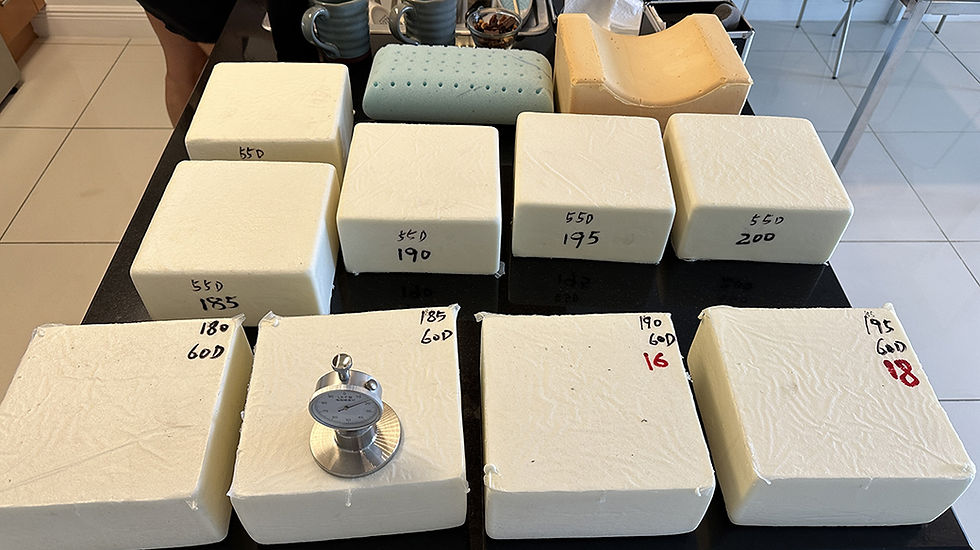
Foam blocks and test shapes from the MultipilloW development process. Photograph courtesy MultipilloW.
What did the numerous prototypes teach you about the difference between a good idea and a product that actually works?
The prototypes taught me that a good idea may work once, but a real product must remain comfortable for hours and be repeatable in production. I learned that during a birthday drive from Miami to Niagara Falls with several early prototypes. About four hours after leaving Miami, my back started hurting. I put one prototype behind my lower back, and the drive became manageable. I had not designed it as lumbar support. That was the first unexpected use I discovered on the road.
The trip also exposed a weakness. A prototype could feel good for ten minutes, then lose its structure after several hours. During three and a half years of development, I made more than 40 prototypes. Four manufacturers and several engineers tried to reproduce the shape while keeping the required softness, support, airflow and consistency. They could not repeat what I had made by hand. A real product must work for hours and come off the production line the same way every time.

Early pillow and foam prototypes laid out in a hotel room while Alex was developing the idea. Photograph courtesy MultipilloW.
Why did you choose one adaptable product instead of a purpose-built travel pillow, and what were the hardest compromises?
I chose one adaptable product because solo travellers carry every item themselves. Packing separate pillows for a flight, a hotel bed, and lower-back support would solve one problem by creating another: more bulk, weight and things to manage. A purpose-built neck pillow is useful for only one part of a trip. I wanted one compact product to follow a traveller from the car or plane to the hotel, then remain useful at home or work.
That choice became real on a flight with my wife. We tested one MultipilloW between us, using it in different positions. One compact pillow did the job of two single-purpose travel pillows. That was exactly the point. Making one pillow work in different ways created the main engineering compromise. The pillow had to be soft for the face, structured for the head or lower back, high enough for side sleeping, low enough for back sleeping, breathable and small enough to pack. Improving one quality often weakened another. More softness could collapse the shape. More structure could feel too firm. More size improved support but reduced portability.
The final form measures about 37 × 25 × 15 cm (14.6 × 9.8 × 5.9 inches). Three foam layers provide different levels of softness, structure and airflow, while flipping the pillow changes its working height. The arch also created an unexpected place for the arm during side sleeping. That same shape supports more than 20 uses in bed, a car, a plane, behind the lower back, under the knees, on the lap or with a laptop.
How did portability influence the design, and what did travel itself teach you about pillows and supports?
A pillow has to earn its place in a solo traveller’s bag. Portability was not a feature added at the end. It set the size limit from the beginning. The pillow compresses into a waterproof bag about 15 × 15 × 25 cm (5.9 × 5.9 × 9.8 inches). It can fit inside a suitcase, sit on a suitcase handle or clip to a backpack with a carabiner. That makes it practical for airports and road trips, but also for hiking or camping when every inch of space matters.
Travel taught me that comfort is not only about the hotel bed. The same pillow may support my back in the car, my head in a hotel, my knees while resting or my laptop while I work. Changeable covers also matter. I can use one cover on the road or in the car, then change it before using the pillow at home.
With no guarantee of how consumers will respond, why do you keep backing the idea?
I keep going because the feedback improved as the product improved. Early prototypes received blunt criticism. After the first batch, I gave later versions to employees, friends and people I worked with at the factories. As the design became better, people stopped simply testing the pillow. They asked to keep it. By now, the people closest to me use it too. Later, they thanked me and told me how they were using it at a desk, on a sofa or bed, in a car and while travelling. For some of them, it became a kind of pillow companion that was useful throughout the day.
Manufacturing gave me another reason to keep going. Four factories could not reproduce the geometry I had made by hand. When the engineers ran out of options, I used AI to help work out a sectional mould. The factory built it, but the idea failed: foam that could be moulded did not give me the softness, support and airflow I needed. Finally, one engineer built our own conveyor wire-cutting machine for this exact geometry, which is now used in production. That machine is why the shape can now be made consistently. None of the four factories could achieve it with conventional methods.

An early MultipilloW prototype with its compact travel bag, packaging, and product materials. Photograph courtesy MultipilloW.
There are no guarantees in product development. I believe customers will respond because the pillow has already become part of people’s daily lives, not because I asked them to promote it.