
THE SOLO TRAVELLER
Your world. Your way.
Perspectives

Overlooking the lake on São Miguel island, the largest and most populous island in Portugal’s Azores archipelago.
Where no one knew my name
A Q&A with Bianca Caruana, author of ‘Soul Truth’ and founder of The Goddess Temple Brisbane.
Briefly …
After leaving a successful corporate career during a period marked by anxiety and depression, Bianca Caruana spent years travelling alone through different countries and cultures, searching for something she could not quite define. What began as a journey across borders gradually became a deeper exploration of identity, belonging and the transitions that shape our lives.
As Bianca Caruana moved between cultures and communities, she encountered different ways of understanding life’s major transitions. In many places, experiences of grief, transformation and personal change were marked through ritual, ceremony and collective support rather than navigated alone. These observations would eventually inspire her memoir, Soul Truth, and shape the work she does today helping others navigate life’s significant transitions.
In this conversation, Bianca reflects on the relationship between solo travel and belonging, why so many people set out in search of something more difficult to name than a destination, and what modern society may have lost as traditional rites of passage have faded from everyday life.
You left your corporate career during a period of anxiety and depression. When you think back to that moment, what were you hoping travel might give you that life at home couldn’t?
I felt as though my world was confined – both my inner world and my outer environment. I had taken up a course in travel writing to scratch the itch of something grander than spreadsheets and SAP figures. I vividly recall writing about where to see humpback whales on the eastern seaboard of Australia for an assignment we were tasked with. I wrote about their annual migration during the months of May to September, journeying between the cold feeding grounds of Antarctica and the warmer tropical waters of Queensland. In some way, perhaps a part of me longed to migrate too. After all, we humans are inherently nomadic, and somewhere along our long lineage of ancestors we never knew sameness. But sameness was what I had come to achieve, and something deep in my soul knew it wasn’t meant to be this way.
You describe a search for something not quite named. Did that feeling become clearer as you travelled, or did it evolve into something else entirely?
At first glance, it seemed like the travel was the medicine – as if, with one swig, I would heal from all the discomfort in my body. With hindsight, travel was simply a tool to create the space I needed to meet myself. I had existed for so long in a kind of sleepwalking state … here but not here. The hamster wheel of modern existence had me on autopilot, disconnected from my heart, body and soul. I was in the mind, always in the mind. And I learned that while the mind can get us places, it can also lead us astray. We can become consumed with thought after thought, worried about a future we have not met and a past we cannot change.
It was travel that brought me back into a state of connection with myself and the world around me. During those years abroad, I participated in my reality rather than being an observer of it. And in doing so, I was able to meet the deeper layers of myself and ask myself, “Who am I without the labels? Who am I without what other people expect of me? Who am I?”. This was how I came to know myself as a woman. This was how I learned to meet myself with loving compassion and flow with the rhythms of life, not against them.
Solo travel is often framed as freedom, but how can freedom sit most effectively alongside our human need for connection?
For me, it was about creating balance. The freedom versus community dichotomy is a common discourse in the digital nomad community, a community I came to know well as a solo traveller. We all desired freedom first and foremost yet longed for deeper connection. In many ways, we held close friendships due to our shared values and views. However, we were seldom in the same city long enough to uphold consistency in our relationships. An occasional WhatsApp message would remind us we had friends in faraway places. And when we travelled, we would be welcomed into each other’s homes as if time never existed between us. But time did exist, and during those moments when ‘community’ didn’t surround us in person, it felt lonely.
Moving between cultures, you encountered places where life’s transitions are marked and witnessed. What did that look like in practice, and how did it land with you personally?
I remember the first time I visited the Pashupatinath Temple in Kathmandu, Nepal, a place where death is honoured through sacred ritual. Along the banks of the Bagmati River, funeral pyres burn as families gather in prayer, smoke rising into the air beside chanting, bells and offerings to the divine. I had never seen death so out in the open, literally, and it fascinated me.
It was around this time in my life that I was becoming strangely curious about my own impermanence. In a sense, leaving my corporate career and my identity as a successful business woman felt like a death – a death of identity. It felt as though I was watching parts of myself fall away, just like the ashes that burned in front of me that day in Nepal.
With hindsight, a part of me probably recognised the contrast between ritual in Eastern culture and ritual in Western culture. Eastern culture seems closer to the thresholds of life, death and rebirth. My own unravelling and rebuilding into a new version of me felt familiar yet foreign. No one at home talked openly about death. We didn’t have ceremony or ritual or gatherings to honour life’s transitions. All we seemed to celebrate were birthdays and weddings, and they had become so commercialised.
I wondered, were we missing something?

Receiving a tika blessing while volunteering with a women’s cooperative in Nepal.
It took my own acceptance of impermanence to remember the beauty that can be found in change. We seem to have forgotten how, in order for the flowers to bloom in the spring, the trees must wither in the winter. We seem to have forgotten that endings in all its forms are often required to make way for the new.
I noticed how much of modern culture is laced with the concepts of keeping things as they are – anti-ageing, biohacking longevity, fearing death, avoiding grief, clinging to comfort, preserving identity, staying productive, and especially for women, medicating or suppressing the body through its natural transitions. We are taught to stop our bleeding with the pill, to fear ageing, to conceal menopause, to medicate symptoms rather than treat them as messages from the body and listen to what they may be asking of us. So much of Western culture conditions women to see their cyclical nature not as wisdom, but as inconvenience, and it is not this way in many of the places I visited … at least not yet.
In our Australian culture, I feel we exist with some kind of tendency to rush through life’s transitions and have forgotten to celebrate ourselves at all transitions, not just the joyful ones. I believe that when we can remember the cyclical nature of life, we can find a deeper meaning in our lives and in our communities, bringing us back into relation with one another and the natural world.
Travel can open things up emotionally as much as geographically. Were there moments on the road where the journey turned inward in ways you hadn’t expected?
I remember one moment in a hostel in Chennai where I truly began to question whether I could continue travelling. I felt exhausted, defeated and deeply alone. I was not unsafe in the sense that immediate danger was present, but I felt unsafe in the absence of anything familiar – no comfort, no familiarity, nothing that felt like home. It had been almost nine months of travel at this time. My sustainable travel blog was doing well, but deep down I knew that asking ordinary people to recycle and avoid plastic water bottles felt insignificant beside the environmental footprint of mining magnates, private aviation, and billion-dollar industries.
Travelling with a severe cashew allergy had already become difficult, and for days I had been surviving mostly on plain naan and dahl, trying to avoid getting sick. I had booked into a hostel that appeared lively in the Lonely Planet guide, only to arrive at an empty eight-bed female dormitory.
When I ventured out in search of local attractions, it felt as though I was the attraction instead. Men stared intensely, some following me with their eyes as I walked, others lingering too close. Those of you who have travelled solo through India as a woman will understand that it is not always an easy experience, particularly in places far from the tourist trail. And for those who haven’t, imagine a constant hyper-awareness of your safety that becomes emotionally exhausting.
It was in those moments of vulnerability when I really started to question what I had set out to achieve. “Was the grass greener?” I asked myself. “Had I truly made a difference in the world? Was leaving my life back home all worth it?”. All I knew was that I was a girl on a mission to change the world, but with hindsight, I was actually a girl on a mission to change herself – to know herself. To grow and to experience life in its full spectrum.
“… I was a girl on a mission to change the world, but with hindsight, I was actually a girl on a mission to change herself …”
I subsequently booked a flight to London from Chennai and fell into the arms of my old high school friend Steph, who had relocated to London one year prior. She was the closest person who felt like home, and London was the closest place that felt familiar. Those challenging moments taught me many things, not the least of which is that if you don’t vibe with a place, you can always book a flight and go somewhere else.
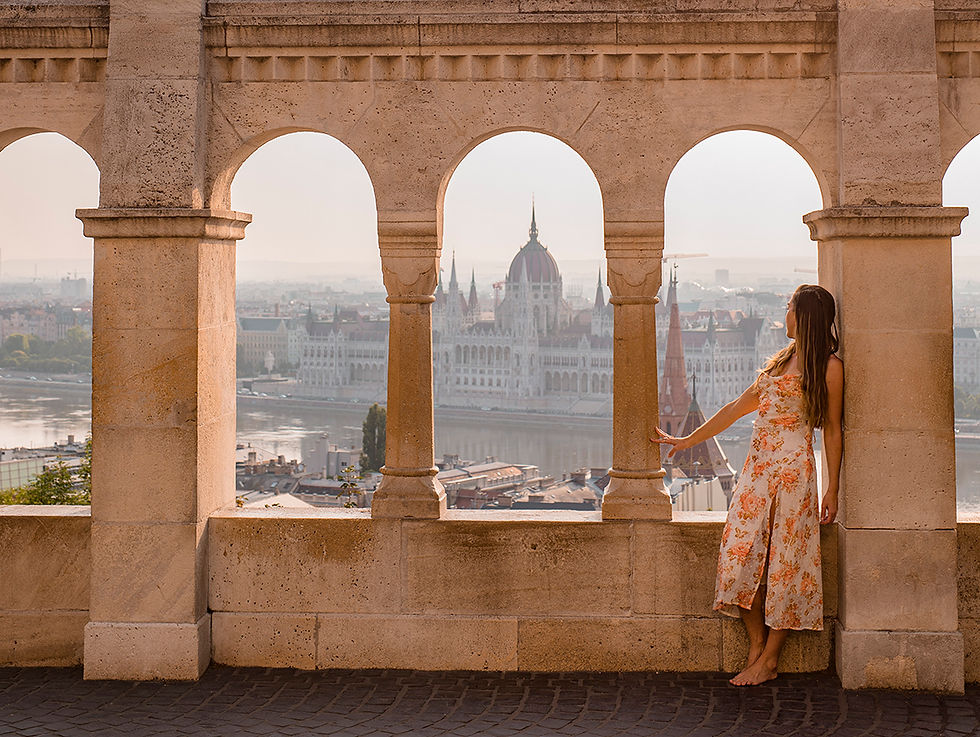
The historic Buda Castle in Budapest.
At what point did you realise that what you were experiencing needed to be written – becoming Soul Truth – not just lived?
I feel as though the chapters of Soul Truth formed in my heart and mind not long after my seven-year relationship had come to its own ending. It had been seven years of loving him, seven years since I had left my corporate career, seven years since I had first set out to travel the world and become the version of me who felt young, wild and free.
So much of the book came forth once I had emerged from the depths of that heartache. After all, some of humanity’s most beautiful art has emerged from heartbreak, longing, and grief. Nostalgia makes for beautiful storytelling, and so it was this inspiration that led me to the keyboard to start writing about my years as a vagabond – the years I said yes to this incredible life and all that it had to offer. So much wisdom fell onto those pages. Some I hadn’t remembered until they came through me those winter months I wrote my book from a small studio apartment in Sliema, Malta. Life does seem to make more sense when we look backwards, doesn’t it?

Bianca at her Soul Truth book launch in North London.
You’ve spoken about ‘belonging’ as something many women are searching for. Did travel help you find it, or did it reshape your understanding of what belonging actually is?
Travel certainly reshaped my understanding of what belonging is, because I came to realise that true belonging with others can only deepen when we also begin cultivating belonging within ourselves. As women, we are so often taught to disconnect from our bodies, to question our intuition, to mould ourselves into what is desirable, acceptable, productive, or pleasing. Many of us spend years trying to belong by becoming different versions of ourselves for different people.
But travel stripped so much of that away for me. There was something profound about being in a city where no one knew my name. In those moments, I began to understand that belonging was never really about fitting in. It was about feeling at home within my own body, my own spirit, and my own truth, wherever I was in the world.
“There was something profound about being in a city where no one knew my name.”
After years of movement, you chose to create spaces for women back home. What did you bring back with you that now shapes the way you hold those spaces?
I feel as though those years spent travelling abroad were the schooling I needed to be where I am now in my life. I don’t feel that any curriculum could have set me up for the lessons and knowledge and wisdom I had gained from almost seven years of travel. I had spent time with Mayan elders in the foothills of Guatemala, learning about their connection to the land and their devotion to ritual. I had slept in thatched-roof huts in the villages of North Vietnam, observing the rhythmic pace of life and the pure happiness woven into ordinary moments.
I had walked the pilgrim paths of Glastonbury beside those devoted to the old ways, witnessing Samhain fires burn against the autumn dark as stories of death, rebirth, and the unseen worlds were spoken as if they were never forgotten. I drank tea with Welsh druids who carried ancient understandings of season, symbol, and ceremony, reminding me that spirituality was once inseparable from the rhythms of the earth itself.
I meditated with monks in the ashrams of Kathmandu, learning about stillness, impermanence, and the endless dance between attachment and surrender. And across these journeys, from mountain villages to sacred temples, I encountered a kind of hospitality that felt almost forgotten in the modern world – people with very little material wealth opening their homes, their tables, and their hearts to me, treating me like I was their kin.
It is all of this – every place, every conversation and every ceremony – that now lives within my own devotion to community, holding ceremonies and gatherings for women from my new hometown of Brisbane, Australia. This is how wisdom has always survived – passed on, carried across generations like a flame that never dies.

Bianca’s community space, The Goddess Temple, in Milton, Brisbane.
For women who feel that quiet pull to travel for something deeper than a holiday, how can they begin to approach that journey without needing to have all the answers upfront?
Our intuition is our loudest compass, yet often we don’t trust those messages from within. This is because for much of our lived experience, we have been taught to look outside of ourselves for the answers. “Trust your gut” isn’t just a saying, it is a guide to listen to our bodies, not our minds. When we can learn to listen to our intuition, we can remember that it is there to serve our highest good.
I would encourage any woman who feels that inner calling to travel to truly listen to it. Perhaps ask for a sign. And then, if you are still unsure, ask for a more direct sign. Sooner or later, the messages grow louder, and you can no longer ignore them. Remember, you are the creator of your life. You are the driver, the storyteller, the muse. Listen to your heart and let it guide you. Your older self will thank you for it later.
You can connect with Bianca via her website here https://www.biancacaruana.com/ and find ‘Soul Truth’ here.