
THE SOLO TRAVELLER
Your world. Your way.
The Loneliness Question – A Health and Wellbeing Series
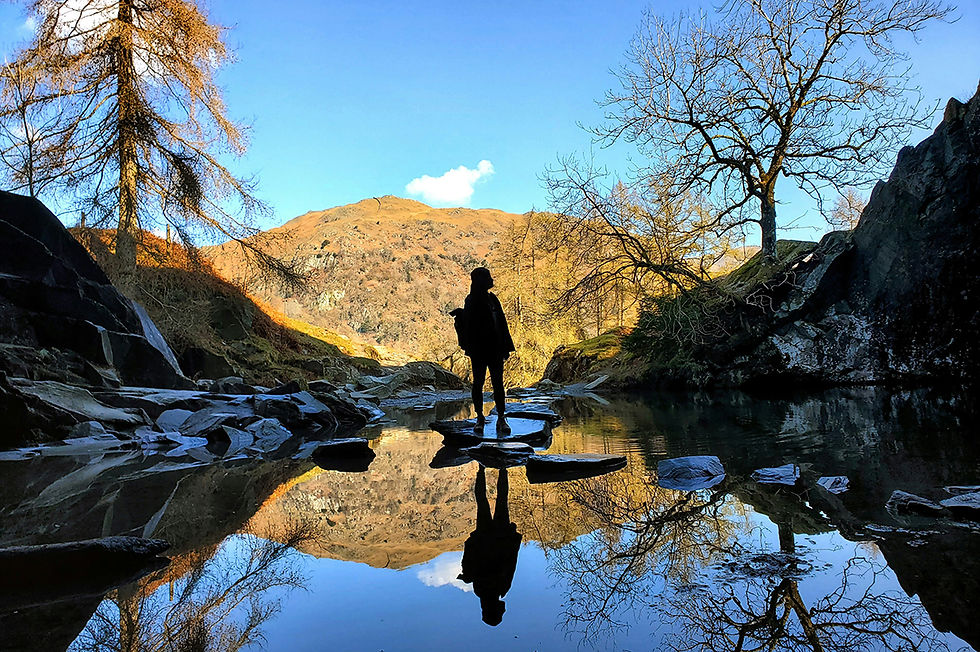
The Lake District National Park, United Kingdom. Photographer: Aniket Das | Unsplash.
At the edge of effort
Solo travel is often seen as a personal test of resilience, independence, and the ability to rely on no one but ourselves. But what happens when that idea begins to fracture? When the moment calls not for endurance, but for support?
Even with the best-laid plans, there are moments when our solo traveller journey narrows – when the noise drops away and what remains is effort, fatigue, and the question of whether to keep going. It is often in those moments that something else appears.
In our exclusive excerpt from The Elite: Think Like an Athlete, Succeed Like a Champion, author Dr Jo Lukins – who has spent more than 30 years working with elite athletes, leaders and teams – illuminates the quiet truth that even the most solitary paths are rarely walked alone.
An edited excerpt from The Elite: Think Like an Athlete, Succeed Like a Champion (Ultimate World Publishing, 2019). Words by
Dr Jo Lukins. Reproduced with permission from Dr Jo Lukins. © 2026. Dr Jo Lukins Pty Ltd. All rights reserved.
Chapter 9 – In Your Corner
When she decided to take on an ultra-endurance race she had no idea just how mentally challenging it would be. Her previous distance had been marathons, but a multi-sport event that would take the better part of the day was something she couldn’t completely comprehend through her months of training. It was raining, it was cold and after 9 hours she just wanted to stop. She hadn’t seen another competitor in the last 20 minutes and the fatigue in her body resonated through her. It felt like even her teeth were tired. Fighting back tears she reached into her backpack and took out the last thing she had that might help, her mobile phone. At the other end of the phone was the one person who could talk her through her pain and get her going again: her mum.
While the athlete competes on the big stage, there is often a team of family and friends who are watching from the wings. They likely have made a sizeable commitment as well as financial and lifestyle sacrifices so that the athlete might pursue their dreams. Standing on the podium to receive their trophy and deliver their acceptance speech, the athlete will invariably always include an expression of gratitude to those who have contributed to their success. This may include coaches, teammates, health professionals, friends, parents and family. Each of these people make a unique contribution, which plays a role in the performance of the elite athlete throughout their career. This moment reinforces a key principle from the work of positive psychology: people matter.
A key finding from the research showed the importance of tending to your relationships as part of your overall health and wellbeing. Social connection and happiness within relationships were a key finding of the research. A further, sobering conclusion is the negative impact that loneliness has on overall wellbeing. Loneliness is as much a threat to our overall longevity as smoking or alcoholism. In the health stakes we can consider social connection a booster and loneliness a poison.
A meta-analysis combines the data of many studies to make broader conclusions about their focus. One such research paper reviewed 148 studies including more than 300,000 participants. This analysis concluded that social connectivity reduced your risk of dying early by 50%. A further consideration of over 70 studies included more than 3.4 million people. It also supported the idea that social isolation and loneliness were linked to a premature death. In each of these large and significant studies the conclusion is simple: people matter.
In a nutshell, having people in your life matters. There are those who have your back, those that support you and those who will hold a mirror up and challenge you when you need it. Knowing you have people who support you is incredibly important. Your ability to be grateful for that gift will enhance those relationships. Further, your ability to support others is an important part of your life experience.
Does asking for help make you weak? No. Asking others for help and sharing your personal vulnerabilities actually takes great strength. Give your friends and family the benefit of your trust in asking them for help when you need it.
Data sources
Julianne Holt-Lunstad, J., et al. (2010). Social relationships and mortality risk: a meta-analytic review. PLOS Medicine, 7(7).
Julianne Holt-Lunstad, J. (2021). Loneliness and social isolation as risk factors: the power of social connection in prevention. American Journal of Lifestyle Medicine, 15(5).

About the author
Dr Jo Lukins is a psychological Indiana Jones, author and speaker who has spent more than 30 years working with elite athletes, leaders and teams. She loves exploring new places – from ski slopes to city laneways – and is endlessly curious about how travel stretches our mindset. Whether she’s running along a coastline at sunrise or people watching in a busy airport, she’s always collecting stories and strategies to help others thrive, wherever they may be.

You can purchase your copy of The Elite: Think Like an Athlete, Succeed Like a Champion on Amazon here, and connect for Jo via her website https://www.drjolukins.com