
THE SOLO TRAVELLER
Your world. Your way.
Learning and Creativity

Image courtesy Himalayan Echoes.
The far more interesting questions
A Q&A with Yeishan Goel
Briefly …
Learning alongside the people who practise Bhutan’s traditions can reveal what sightseeing alone cannot. Curiosity and participation can deepen an encounter, as can understanding when simply to observe.
There is plenty to see in Bhutan, from mountain landscapes and monasteries to colourful festivals. But seeing something and understanding it are different propositions. For solo travellers, learning can also change the nature of an encounter. Taking part creates a reason to spend time together, ask questions and occasionally make mistakes, while some traditions require something quite different – understanding when participation is appropriate and when the traveller’s place is simply to watch.
Himalayan Echoes co-founder Yeishan Goel designs private journeys through Bhutan that connect travellers with artisans, practitioners and local experts. He shares why curiosity can reveal more than sightseeing alone and why arriving ready to learn can also mean arriving ready to have some assumptions challenged.

Image courtesy Himalayan Echoes.
What can educational and personal development opportunities alongside local practitioners reveal about the country that conventional sightseeing often cannot?
Sightseeing answers the question “What is this?” Sitting with a practitioner answers the far more interesting one, which is “Why?” You can photograph a dzong, the fortress-monasteries that anchor each valley, in an afternoon and leave knowing very little.
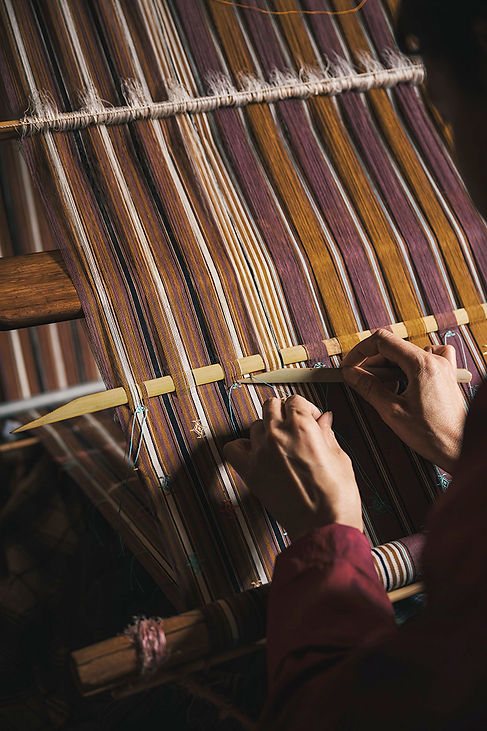
Spend a morning at a loom in eastern Bhutan and you learn that the finest Bhutanese textiles, woven in silk with patterns lifted by hand thread by thread, take the better part of a year to finish. You learn the pattern was passed down from a mother or an aunt rather than taught at school, and that a cloth like this is inheritance and status here, passed down and worn at the most important moments of a life, rather than a souvenir. You understand why the country treats its craftspeople as guardians of something rather than as a cottage industry. The same is true of archery, which visitors assume is a sport and is in fact a social system, with songs sung specifically to unsettle the man taking the shot. Or of meditation, which is not wellness here; it is an everyday practice, done by people who then go to work.
None of that is available from sightseeing alone. It comes from spending time with the people who practise these traditions, which is precisely why we build meetings with local people – monks and historians, weavers and mask makers, artists, conservationists and authors – into every journey we design. Bhutan rewards travellers who get under its skin, and we would much rather someone went home having learned something than having simply seen a great deal.
For solo travellers, how does learning a skill or joining a cultural practice change the dynamic of an encounter with local people?
A solo traveller may be warmly welcomed, but it can take time to move beyond feeling like a guest and genuinely becoming part of what is happening. Joining a practice moves you inside it. Once you are part of an archery team, you are part of the teasing and the arguments about whose turn it is. Once you are in a kitchen, someone hands you something to chop and stops explaining what everything is.
What follows is usually the good part. The lesson finishes, the tea appears, and the conversation carries on without anyone deciding it should. Those are the encounters people remember, and they rarely come from being shown around. They come from having been useful, or at least willing.
How do you create opportunities for travellers to participate and learn without reducing those traditions to tourism experiences?
We start from the belief that these practices are not ours to offer. They belong to the monastery, the artist, the family whose ritual it is. Nothing is contrived or created to suit a traveller’s desires. If a ceremony belongs to a particular day in the calendar, it happens on that day or it does not happen at all. Some things are open to participation, and some are for sitting quietly at the back, and we say which is which before anyone arrives, because a traveller who understands why they are there to observe rather than participate is not disappointed by it.

Image courtesy Himalayan Echoes.
What makes those encounters genuinely educational rather than simply demonstrations, and how much does the traveller’s own curiosity shape what they take from them?
A demonstration is something you observe; an educational experience is something you participate in. It requires enough time to try, make mistakes, ask questions and be guided and not simply watch someone perform a skill. Thirty minutes with a weaver may show you what she does, but a full morning allows you to understand the person, knowledge and traditions behind the craft. Once the formal explanation is over, the more revealing conversations begin – who taught her, which parts she finds difficult or tedious, and whether the next generation wants to continue the tradition. Those unscripted exchanges are often where the real learning happens.
A traveller’s curiosity ultimately determines the depth of the experience. We can create the access and conditions, but our guests must engage. Often, the simplest questions reveal the most: “How long did it take to become skilled?”, “Who taught you?”, “What happens if no one carries this forward?” The answers offer insights that no guidebook or prepared demonstration can provide.

Images courtesy Himalayan Echoes.
What would you encourage them to arrive curious about, and what preconceptions might they be prepared to have challenged?
I would encourage people to arrive curious about ordinary life in Bhutan, not only the festivals, monasteries and iconic sights. Ask what people do on a normal Tuesday, what young Bhutanese hope for, how families make decisions and how the country is changing. The ceremonial side of Bhutan is beautiful, but it is often the everyday conversations that give you a real sense of the place.
Most importantly, come with an open mind. Something may initially seem unusual – or even “wrong” – simply because it is different from the way things are done in the West. That does not make it wrong; it may be completely normal and appropriate here. Be prepared to let go of the idea that Bhutan is permanently serene or frozen in time. It is modern, connected, opinionated and very funny. Monks have phones, follow sport and enjoy socialising. Happiness does not mean everyone is constantly content, either. Gross National Happiness is a policy framework involving real choices and trade-offs, not a description of the national mood.
And for anyone worried about travelling alone, be open to having that assumption challenged too. In Bhutan, travelling solo rarely means being lonely. In many ways, it makes conversations easier and allows doors to open more naturally.