
THE SOLO TRAVELLER
Your world. Your way.
Ecotravel
Photographer: Picture Partners | iStock.
Just in case
By Emily Clarke
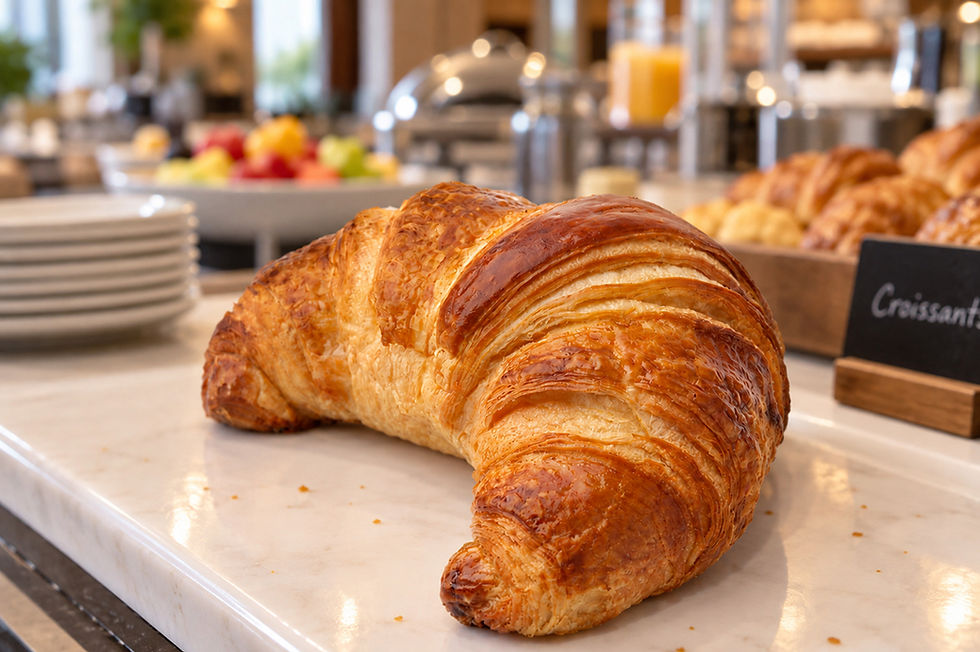
Our poor innocent croissant has quite a complicated biography. It is sitting on a hotel breakfast buffet somewhere in the world, looking perfectly harmless. Somebody decided how many croissants would be needed that morning. Somebody ordered them, made them or had them delivered. Energy was used to produce them, transport them and keep them fresh. Then somebody arranged enough of them on a tray to make breakfast look generous. Perhaps we take one. Perhaps we do not. Perhaps nobody does.
At the end of breakfast service, our croissant may have fulfilled its purpose without ever being eaten. It was available and the buffet looked plentiful. Nobody arrived at 9.45 to find a lonely piece of toast and the unmistakable sense that everybody else had beaten them to breakfast. What happens next depends on where we are and how the hotel operates. It could be reused safely, redirected, composted or discarded. By then, though, we are asking a question about what to do with waste. What if we asked an earlier one – “How do we avoid waste before we create it?”
Much of the conversation about waste begins and ends at the bin. Which one should we use? Can this be recycled? Can food scraps be composted? Should the plastic bottle go somewhere different from its cap? They are useful questions, but they come remarkably late in the life of whatever we are holding. Travel surrounds us with things somebody has already decided we will need – bottled water, mini toiletries – and often we do. That makes travel waste more complicated than a story about careless travellers throwing things away. By the time we make the decision to use something or leave it untouched, many of the decisions that determined its environmental cost have already been made.
The problem becomes particularly visible in the Pacific, where bringing something onto an island can be considerably easier than dealing with it once its useful life is over. The Secretariat of the Pacific Regional Environment Programme’s State of the Environment and Conservation in the Pacific Islands: 2025 Regional Report describes waste and new types of waste as an “ongoing and growing challenge” across the region.
For decades, part of the language of hospitality has been abundance: making sure the guest does not have to ask and that the level of provision meets our expectations – however fanciful or unrealistic they may be. The difficulty is that anticipating what hundreds of different people could want inevitably means providing things some of them will not. Food makes the problem particularly visible. According to the United Nations Environment Programme, 1.05 billion tonnes of food were wasted in 2022, with food service accounting for an estimated 290 million tonnes. The croissant has plenty of company.
Yet simply telling a hotel to put fewer croissants on the buffet completely misses the problem. Waste can result from excess, but it can also result from trying to provide a reliable service. Refusing the little bottle of shampoo may prevent us from opening it, but it doesn’t determine whether the hotel bought it in the first place. The more interesting changes therefore happen further back. Can toiletries be supplied from refillable dispensers rather than individual containers? Can drinking water be provided without automatically putting disposable bottles into every room? Can food demand be predicted more accurately?
None of those questions require us to become an environmental auditor every time we check into a hotel. We do, however, make our own decisions before we get there. Travel encourages its own peculiar form of precautionary consumption, and while some of that is sensible preparation, in my case it is the material expression of three remarkably powerful words: ‘just in case’. So, did I need it? Was I actually going to use it? Would I still want it when I came home? The least complicated piece of waste may be the one that never becomes an object in the first place.
“The least complicated piece of waste may be the one that never becomes an object in the first place.”
Recycling remains part of the answer, as do composting, reuse, redistribution and better waste management. But they deal with something that already exists. Prevention asks us to move backwards through the biography – past the bin, past the moment of consumption, past the point of purchase and towards the decision that caused something to be produced, supplied or bought.
For travellers, that can mean questioning our own just-in-case purchases and taking only what we will use. For the systems around tourism, it means examining whether convenience, efficiency and expectations have made unnecessary consumption part of delivering the experience. None of this requires the end of the breakfast buffet. It simply requires us to look at our poor innocent croissant before it reaches the bin and ask a rather more useful question: Did it need to be there in the first place?
Sources
Secretariat of the Pacific Regional Environment Programme (SPREP). (2026). State of Environment and Conservation in the Pacific Islands : 2025 Regional Report, Second Edition.
United Nations (UN). (2024). Food Waste Index Report 2024. UN Environment Programme.