
THE SOLO TRAVELLER
Your world. Your way.
Tools and Tech

Image courtesy Polarsteps.
Our growing desire for meaning over momentum
By Josh Chandler
Briefly …
Using anonymised travel data and traveller insights, we explore how digital tools are shaping the way solo travellers plan, move, and reflect on their journeys. What do these patterns reveal about our changing travel behaviours, and why do they matter when we travel independently?
Travel apps don’t just help us navigate unfamiliar ground – increasingly, they reveal how travel itself is changing. When millions of journeys are tracked anonymously and collectively, patterns emerge that go beyond individual itineraries, offering a snapshot of how, where, and why we’re moving through the world.
Recognised as one of Europe’s hottest scaleups, Polarsteps helps over 18 million travellers worldwide to plan, track, and relive their adventures. Using pioneering technology and design and powered by an international team of 90+ passionate travellers, the all-in-one app builds itineraries, maps travellers’ paths across the globe in real-time, and provides a new way to share travel experiences. 2025 was a record year for Polarsteps travellers, who covered almost 24 billion kilometres. Yes, 24 billion kilometres … and to put that into perspective, that’s something like eight return trips from Earth to the Sun.

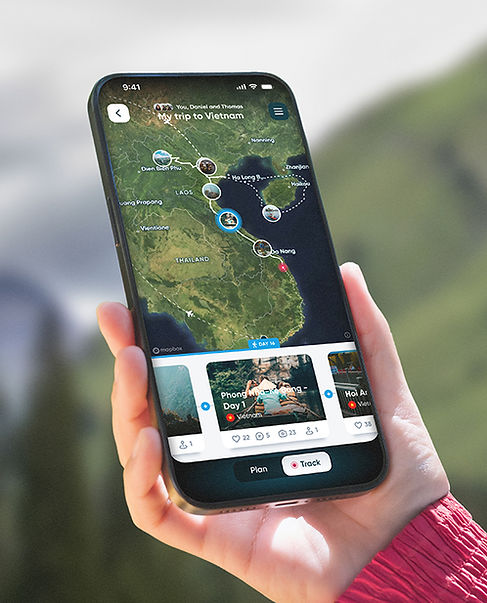
Left: A spectacular hiking trail; and tracking a trip on the Polarsteps App. Images courtesy Polarsteps.
Drawing on anonymised data from more than 4.5 million tracked trips, Polarsteps’ 2025 travel insights offer a ground-level view of global travel behaviour – not from border counts or airline reports, but from travellers recording journeys as they unfold. What emerges is a picture of travel shaped by climate, culture, geopolitics, technology, and a growing desire for meaning over momentum.
Europe still leads, but travellers are looking north and east
Europe remained the most travelled continent overall in 2025, with countries like Germany, France, Spain, Italy, and the United Kingdom continuing to dominate. Yet beneath that stability, subtle shifts tell a more interesting story.

The Old Town of Tallinn, Estonia. Photographer: Ilya Orehov | Unsplash.
The Baltic States – Lithuania, Latvia, and Estonia – recorded some of the fastest growth in Europe, reflecting a wider move towards so-called ‘coolcation’ destinations. As Summers grow hotter across the continent, travellers are seeking cooler climates, fewer crowds, and places that feel less overrun. Relative affordability, improved flight connections, and a quieter pace have all played a role.
Further south-east, Bosnia and Herzegovina and Montenegro also gained momentum, buoyed by outdoor experiences, improving infrastructure, and an appeal that feels less polished (and less pressured) than some of Europe’s long-established hotspots.
A pause in the USA’s momentum
After a strong resurgence in 2024, travel to the United States slowed markedly in 2025. Despite a favourable exchange rate, the number of travellers entering the country fell, coinciding with tighter border controls and shifting geopolitical perceptions. For many travellers, particularly those planning longer or more complex trips, ease of entry and emotional comfort matter as much as cost. The data suggests these considerations are increasingly shaping destination choices.
Asia’s quiet recalibration
Asia saw some of the most dynamic changes in 2025. Japan surged into the global top tier, alongside renewed interest in China and South Korea. Cultural influence – from film, television, and pop culture – played a role, but so did perceptions of safety, infrastructure, and climate. At the same time, parts of Southeast Asia plateaued or dipped slightly, suggesting not a loss of appeal but a diversification of interest, with travellers appearing more willing to look beyond familiar routes.

Kyrgyzstan. Photographer: Mick Truyts | Unsplash.
Perhaps the most striking growth came from Central Asia. Countries such as Kyrgyzstan, Uzbekistan, Tajikistan, and Kazakhstan recorded substantial increases, reflecting a growing appetite for destinations that combine history, landscapes, and community-based tourism. For many solo travellers, these regions offer a sense of discovery that feels increasingly rare.
Africa – heritage, islands, and shifting safari patterns
In Africa, destinations rich in cultural and historical heritage led the way. Ethiopia, Morocco, Tunisia, Egypt, and Senegal all saw strong growth, supported by improved air links and renewed investment in tourism infrastructure.

Egypt. Photographer: Albert Dehon | Unsplash.
Island nations in the Indian Ocean – including Madagascar, Mauritius, and Seychelles – also performed strongly, reflecting ongoing interest in slower, nature-led travel. By contrast, several traditional safari destinations experienced slight declines, with Tanzania standing out as an exception. The shift suggests travellers are broadening their understanding of what African travel can look like, beyond classic wildlife itineraries.
South America’s reshuffle
Brazil emerged as South America’s strongest performer, climbing steadily thanks to expanded international connections, increased global visibility, and new travel experiences focused on the Amazon and beyond. Colombia and Argentina remained popular but slipped slightly in relative terms, as travellers redistributed their attention across the continent.
How travellers are planning and questioning travel itself
Alongside movement data, traveller surveys reveal changing attitudes behind the journeys. Most travellers remain motivated by discovery and nature, with outdoor experiences ranking highest. Yet planning styles are evolving. While few identify as meticulous planners, most prefer to lock in the fundamentals before departure, balancing structure with spontaneity.
AI is beginning to enter the planning conversation. Around one in five travellers already use it for inspiration, while many more are considering it – particularly in parts of Europe. At the same time, a significant minority reject AI entirely, citing trust and accuracy concerns. The data suggests travellers want tools that enhance judgement, not replace it.
Social media continues to divide opinion. Many travellers view its impact on destinations as mixed or negative, particularly where visibility leads to overtourism. The tension between inspiration and saturation remains unresolved.
Environmental awareness, however, is becoming more tangible. Nearly half of surveyed travellers have chosen slower or longer journeys to reduce their impact, with overland routes increasingly forming part of the story, not just the means.

Khlong Sok, Thailand. Photographer: Robin Noguier | Unsplash.
The early indicators for 2026
Planned trips for 2026 suggest Asia will continue to gain ground, with Thailand, Japan, and Vietnam attracting strong interest. Australia also reappears prominently, reflecting long-haul planning habits and renewed confidence. While some European destinations have slipped in early rankings, the data suggests this may reflect timing rather than decline – long-haul trips tend to be planned earlier, particularly by European travellers. What’s clear is that travel is becoming less about ticking destinations off a list and more about how journeys fit into wider lives, values, and constraints.
For solo travellers, tools like Polarsteps offer more than logistics. They provide a way to reflect, record, and understand our place within a much larger movement. When millions of individual journeys are viewed together, they remind us that solo travel is deeply personal but never isolated. We may travel alone, but we are always part of a wider story.
You can learn more about Polarsteps on their website here.
Josh Chandler is a devoted solo traveller and travel writer based in Europe.
About the Polarsteps source data
The 2025 travel trends are based on anonymised data from more than 4.5 million tracked trips in the Polarsteps app between 1 November 2024 and 31 October 2025. This data was compared with the previous 12 months and adjusted to remove any bias from Polarsteps’ rapid growth in traveller numbers. Countries with low travel volumes were excluded to ensure statistical accuracy. Trip trends for 2026 are based on anonymised data from 200,000+ planned trips for 2026 on 31 October 2025. The travel survey results are based on 3,047 respondents from the Netherlands, France, Germany, Belgium, Australia, the United States of America, and Spain, collected in November 2025.