
THE SOLO TRAVELLER
Your world. Your way.
Hiking and Trekking
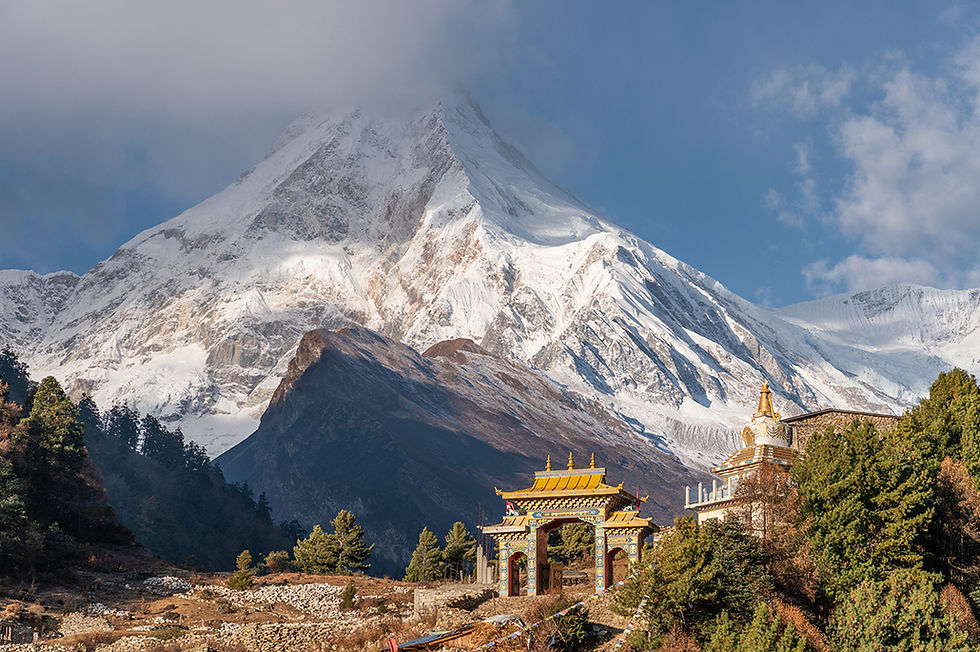
A Tibetan monastery and the Manaslu mountain peak, the eighth highest peak in the world, Nepal. Photographer: Skazzjy | iStock.
#NepalCalling
By Geoffrey Williams, with contributions from RajBala Treks and Expeditions in Kathmandu.
Briefly …
After the catastrophic Rasuwa flood, Nepal is calling trekkers back. But what does that actually look like when some trekking regions were untouched while roads, bridges and access routes elsewhere were destroyed?
Within days of the catastrophic 26 August Rasuwa flood, the Nepalese government launched #NepalCalling, urging international travellers not to abandon the country. Tourism Minister Khadak Raj Poudel was unequivocal: “Nepal is still open … Our Himalayan trekking routes are still waiting for you.”
The difficulty with that invitation lies in the scale of the catastrophe it followed – and the images through which much of the world witnessed it. For days, international coverage carried horrific images of communities being overwhelmed, bridges collapsing and roads disappearing beneath floodwater. At least 1,453 people have died and 5,285 remain missing, according to Nepal’s National Disaster Risk Reduction and Management Authority, after a massive rock-and-ice collapse sent water, debris and boulders through the Bhote Koshi–Trishuli river system.
Asking travellers to return after seeing those images is complicated, but so is asking them to stay away. Poudel made the economic argument explicit: “You coming to Nepal now is not just for a holiday. It is also a great help to the country.” The disaster did not affect Nepal uniformly, and many of its major trekking regions were untouched. Guides, porters, lodge owners, drivers and communities elsewhere in the country continue to depend upon travellers arriving.
That is where #NepalCalling becomes a question rather than simply a campaign. Travelling because Nepal needs tourism income cannot make a damaged road passable, restore a bridge or establish that a particular route is safe. Staying away from an unaffected trekking region because of a catastrophe elsewhere in the country has consequences of its own. For trekkers considering Nepal, neither the images of devastation nor the assurance that “Nepal is still open” tells us enough. What matters is where we are going, how we will get there and what has changed since the disaster.
Lata Sharma, Managing Director of Kathmandu-based RajBala Treks and Expeditions, has given The Solo Traveller permission to draw extensively from two updates following the disaster. One examines conditions around Langtang, while the other considers what the Rasuwa flood means for trekking elsewhere in Nepal. The broader assessment begins with an important distinction: “There is no single safety status that applies to the whole country.”

Lowo Nyiphug Namdrol Norbuling Sun Cave Monastery near Chhoser Village, Upper Mustang, Nepal. Photographer: Jasper Neupane | iStock.
The broader assessment separates Nepal’s trekking regions according to how they were affected rather than treating the disaster as a national condition. Rasuwa and the transport corridor towards Langtang suffered direct damage, while major trekking regions including Everest, Annapurna, Mustang, Kanchenjunga, Makalu, Dhaulagiri and Dolpo were outside the area directly affected by the flood. Their update explains that the flood seriously affected some trekking access routes without affecting Nepal’s entire trekking network. That distinction matters for travellers who saw images of devastation from Nepal and reconsidered journeys elsewhere in the country. It does not mean that every trek outside Rasuwa is therefore safe or operating exactly as it did before.

Langtang, Nepal. Photographer: Evgeni | AdobeStock.
Langtang presents the more complicated case. The valley itself was not directly hit by the main flood, but flood damage severely disrupted the usual journey from Kathmandu through Dhunche to Syabrubesi, the traditional starting point for the trek. As the Langtang update puts it: “The important point is that trekking destination status and access-route status are not always the same.” That difference is substantial for a solo traveller working from an itinerary researched or booked before 26 August. The destination may still be viable and accommodation available, while reaching it now involves a materially different journey. Alternative approaches can add trekking days, take travellers over higher terrain and alter the physical demands and acclimatisation profile of the trek.
Trekking agencies have adapted. One approach continues through Dhunche, Bharkhu and Thulo Syabru before descending towards Bamboo to rejoin the upper Langtang trail, avoiding the flood-hit Syabrubesi corridor. A considerably longer approach from Sundarijal in the Kathmandu Valley links with Langtang via Chisapani and Gosaikunda. The practical advice from RajBala Treks and Expeditions is therefore straightforward: “Do not rely on outdated information. Check the route before you travel.”
The economic argument behind #NepalCalling nevertheless remains. Tourism supports livelihoods throughout Nepal, including in trekking regions untouched by the Rasuwa flood. Avoiding unaffected regions does not assist recovery in Rasuwa and can instead transfer some of the economic consequences of the catastrophe to communities elsewhere.
The two updates from RajBala Treks and Expeditions are equally clear about where that argument stops. “Responsible tourism does not mean travelling into an unsafe area simply to support tourism,” the Langtang account cautions, while the broader assessment puts the distinction another way: “Supporting Nepal does not mean taking unnecessary risks.”
Those words carry particular weight coming from a Nepalese trekking company whose livelihood depends upon people continuing to visit. Supporting the country and assessing the conditions of a particular journey do not need to produce the same answer. Everest is not Langtang. Annapurna is not Rasuwa. The condition of one trekking region cannot tell us the condition of another.
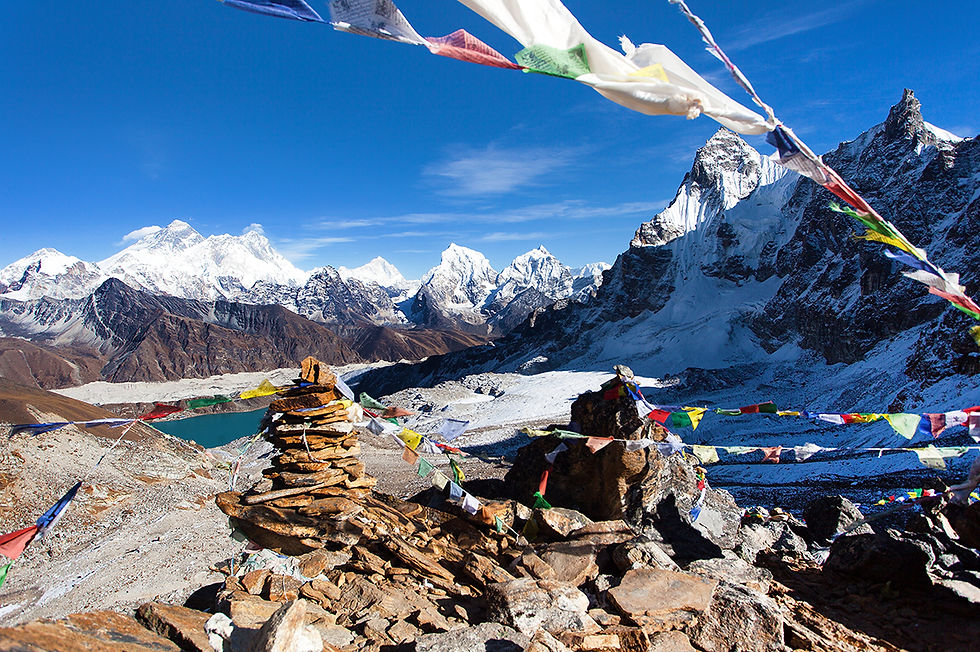
Mount Everest, Lhotse and Makalu seen from Renjo La pass, Nepal. Photographer: Daniel Prudek | iStock.
The two updates ultimately offer a more useful measure than either staying away from Nepal or returning because Nepal needs visitors: “Responsible tourism means travelling when the destination is ready to receive visitors.” Determining that requires more than an image of catastrophe, just as it requires more than a national assurance that Nepal remains open. For trekkers, it means understanding which part of Nepal we intend to walk through, how we will reach it and what has changed since the journey was planned.
#NepalCalling is a genuine invitation to return. Whether we accept it depends on where in Nepal we are planning to go.
The Solo Traveller Group thanks RajBala Treks and Expeditions for permission to draw extensively from their two post-flood trekking updates in preparing this article. You can learn more about RajBala Treks and Expeditions on their website.
The Nepal Red Cross is accepting donations to support people affected by the Rasuwa floods.
Sources
ETTravelWorld. (8 September 2026). Flood-hit Nepal moves to avert tourism crisis.
RajBala Treks and Expeditions. (23 September 2026). Trekking in Nepal After the Rasuwa Flood: Safety, Access and Current Trekking Updates.
RajBala Treks and Expeditions. (23 September 2026). Langtang Trek After the Rasuwa Flood: Safety, Access and What Trekkers Need to Know.
Reuters. (2 October 2026). Nepal plans to drain four glacial lakes after deadly floods.