
THE SOLO TRAVELLER
Your world. Your way.
Adventure

Mount Kilimanjaro in Tanzania, Africa, is the most recent climb for the Seven Summits Sustainability Project Lead Researcher Chrystie Watson, from Charles Darwin University, Darwin, Australia. Photographer: Chrystie Watson.
In the shadow of the summit
A conversation with Dr Chrystie Watson, Adventurer and Lead Researcher for the Seven Summits Sustainability Project
Briefly …
Climbing the world’s highest peaks has surged in recent decades – and so have its consequences. From Mount Kilimanjaro to Everest, a new Australian-led research project is examining how mountaineering shapes fragile environments, local economies, and the people who move through them.
Climbing the world’s highest mountains has long been framed as a personal challenge, defined by endurance, ambition, and the undeniable pull of the summit. But across the Seven Summits, that pursuit is now intersecting with something far larger: environmental strain, economic dependence, and the evolving responsibility of those who choose to climb.
A research project – the Seven Summits Sustainability Project – led by Australia’s Charles Darwin University (CDU), in collaboration with global mountaineering guide service Climbing the Seven Summits, is examining exactly what that intersection looks like in practice – across continents, cultures, and some of the most fragile environments on Earth.
The highest peaks on each of the seven continents are Mount Kosciuszko in Australia, Mount Everest in Asia, Mount Kilimanjaro in Africa, Denali in North America, Aconcagua in South America, Vinson Massif in Antarctica, and Mount Elbrus in Europe, with Mont Blanc, on the border of France and Italy, currently serving as a proxy for Mount Elbrus in Russia.
Principal researcher, CDU Lecturer in Sustainability Leadership and Management and adventurer, Dr Chrystie Watson, said her most recent climb on Tanzania’s Mount Kilimanjaro, which has a peak of 5,895 metres, underscored the socioeconomic importance of these destinations. “Local communities rely on the economic and social benefits realised through the global appeal of the mountain, drawing visitors from around the world,” Dr Watson tells The Solo Traveller. “Tens of thousands of local jobs are associated with visitors to the Kilimanjaro region, including guide and porter services as well as park management and local businesses.”
“Tens of thousands of local jobs are associated with visitors to the Kilimanjaro region …”
Mount Everest is one of the most prominent examples, with the region receiving tens of thousands of visitors each year, resulting in erosion and significant amounts of waste left behind. “Glacial melt and run-off from the mountains feeds river systems which serve as vital water sources and support local agriculture and livelihoods,” Dr Watson said. “Mountaineers and mountain workers play a key role in managing the impacts of their activities on the mountain. On Kilimanjaro, our Tanzanian guides collected rubbish along the trail left by other climbers that was later transported down the mountain by porters, however, preventative solutions are necessary and the responsibility of every climber.”
Thus far, Dr Watson has traversed Mount Kosciuszko in 2024, Mont Blanc in 2025, and Mount Kilimanjaro in January 2026. A second climb of Mont Blanc is scheduled in June this year as part of an expansion of the project in partnership with local Chamonix based guide company, Adventure Base.
Mountain environments are essential to global ecosystems and local regions – and central to this work as they continue to experience serious and increasing environmental degradation. To understand how this plays out on the ground, we spoke with Dr Chrystie Watson about the realities behind the climbs.

Dr Chrystie Watson, Adventurer and Lead Researcher for the Seven Summits Sustainability Project.
What first drew you to focus your research on mountaineering across the Seven Summits? Was it an academic curiosity, or something more personal?
Growing up in the mountains of British Columbia, Canada, my youth was spent outdoors. As an adult, I continue to be drawn to objectives that allow me to explore remote areas and challenge myself physically and mentally. While I did not realise it at the time, undertaking many of the well-known Australian treks (including soloing the Larapinta, Overland and Jatbula tracks), all but one of the State Eight (the highest peaks in each state and territory; Mt Woodroffe in South Australia is currently closed to visitors), and countless hikes and other adventures, was building the groundwork for the Seven Summits Sustainability Project.
As a single parent raising two incredible sons in my birthplace, Australia, my focus for many years was on supporting my family and finding open spaces for two very active and adventurous boys to explore. As my boys grew into young adults, I spent more time seeking solace and peace in the mountains. Through my adventures, I met amazing people who also sought outdoor adventures, but I came to realise these spaces were not being treated well by all who visited.


Dr Chrystie Watson, Adventurer and Lead Researcher for the Seven Summits Sustainability Project.
I do not recall exactly how the Seven Summits came into my view, but I found myself immediately drawn to it and highly conflicted by it. On one hand, it was an opportunity to take on a great challenge that would push me well beyond anything I had set my sights on previously and to explore different parts of the world in doing so. However, the increasing popularity of the Seven Summits meant that I would be contributing to the overcrowding and degradation of these mountain regions.
After two years of internal debate, I decided if I were to take on the challenge of the Seven Summits, I would do it in a way that allowed me to contribute to the care and sustainability of the regions. Fortunately, global guide service company, Climbing the Seven Summits, shared my enthusiasm for sustainability leadership in the mountains and agreed to be the primary guide service for my Seven Summits climbs and industry partner on the Seven Summits Sustainability Project.

Aconcagua, located in Argentina's Mendoza Province, is the highest mountain in the Americas. Photographer: Jens Peter Olesen | Unsplash.
Across the climbs you’ve completed so far, what has most surprised you about the relationship between mountaineering and local communities?
I had read about the increase in mountaineering interest and activities globally, but this really did not prepare me for experiencing the volume of climbers and associated local economies built around the industry. By way of example, I was one of nine climbing clients on the Climbing the Seven Summits Kilimanjaro climb earlier this year. We had one lead guide from Australia, one lead Tanzanian guide, three supporting Tanzanian guides and between 30 and 40 porters, chefs and other camp workers, with a 1:1 porter/guide-to-client ratio on summit day.
On Mont Blanc, the huts and guides are pre-booked months prior to expeditions and are fully booked within days or weeks. We experience similar trends in Australia with booking popular treks, such as the Overland and Jatbula, in terms of volume of interested recreationalists, but the employment created through guided expeditions in high altitude mountain areas is extraordinary.
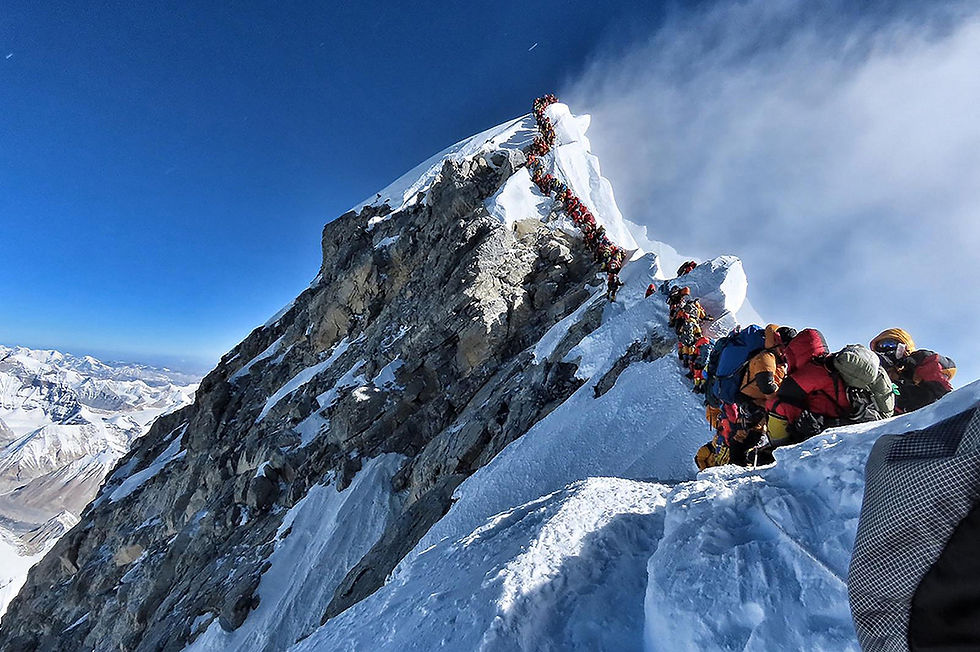
A queue to the top of the world – the summit of Mount Everest. Photographer: Suraj Pokhrel | iStock.
On Mount Kilimanjaro, you observed the economic importance of climbing tourism. How do local communities balance dependence on that income with the pressures it brings?
It is particularly challenging for developing nations to mitigate the risks of a thriving (possibly overdeveloped) tourism industry. It was evident in Tanzania that Mount Kilimanjaro received particular management attention as the main point of interest for visitors and source of local employment in the region. Management measures to reduce rubbish and maintain social cohesion and safety were evident on the mountain. The surrounding communities, however, clearly showed signs of a developing country with poverty evident.
Many of the members of the Mount Kilimanjaro climbing team donated gear and clothing to our porters and guides following the climb as small contributions to supporting their ongoing work in the mountains despite having limited financial means. It was a humbling experience to climb with the professional, kind, strong and hard-working Tanzanian people supporting our expedition, but to be spending thousands of dollars to be there and having the best, highest quality gear and clothing alongside people with much less highlighted a disturbing paradox. Visitors to these regions bring essential and direct economic benefits to the local communities and we are looking into initiatives that will best support the mountain workers in particular.
Your research touches on environmental psychology. What have you noticed about how mountaineers successfully prepare for extreme environments?
Our preliminary data is suggesting mountaineers are primarily intrinsically motivated, with less attention to external influences such as the opinions of family, friends and even the guide companies. This intrinsic motivation became ever more evident when conversing with fellow climbers on the topic of their pre-expedition physical training programs, requiring intense and prolonged endurance and strength components. While we do not currently have enough data to claim definitive findings, there does seem to be early indications that sustainability activism will also need to be intrinsically motivated.
Waste and environmental degradation remain major concerns. Is this primarily a systems issue or a behavioural one?
The issues of waste and environmental degradation in mountain regions are due to a combination of factors, including systems and infrastructure, management policies and regulations, and behavioural and environmental elements. A key component is a lack of education, information and associated actions to mitigate these issues. Consistently, we are finding mountaineers are not aware of or informed of the environmental vulnerabilities of the regions they are visiting. This presents a great opportunity for the project and partners to raise awareness through our interactions with visitors to the mountains and to set sustainability standards on guided expeditions.
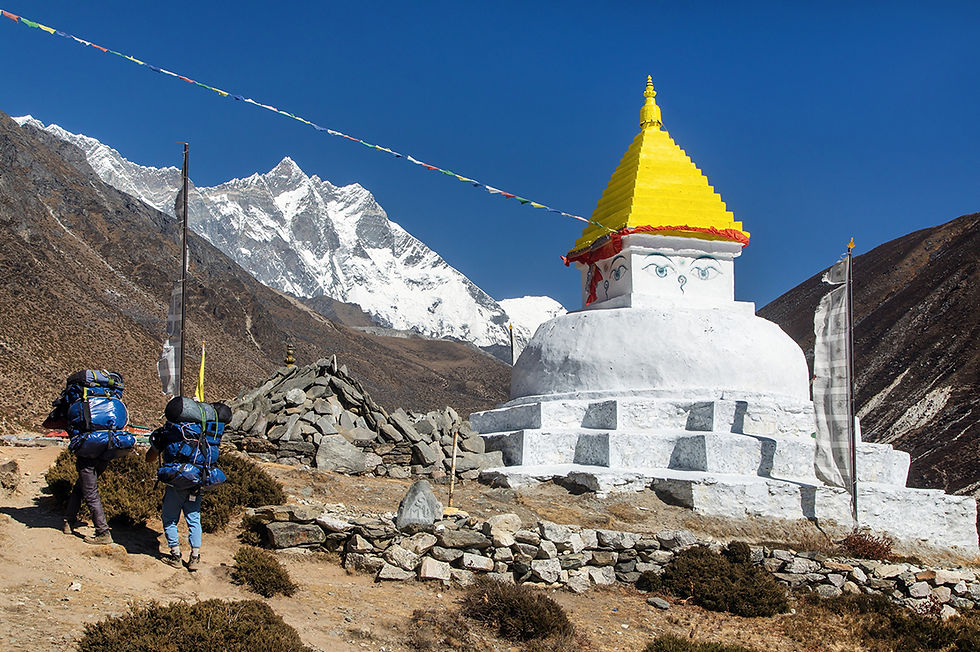
Two Sherpas, on their way to Mount Everest base camp, pass a Stupa – a sacred, dome-shaped Buddhist monument symbolising the enlightened mind and Buddha’s spirit. Photographer: Daniel Prudek | iStock.
You’ve seen guides and porters actively managing the impact of climbers. How central are they to the sustainability of these environments, and are they given enough recognition?
Participatory action from within the climbing community is essential to the success of sustainability initiatives. Guides and porters are central to the industry and represent an important potential source of sustainability leadership. In simple terms, these expeditions just do not happen without them. On guided climbs, guide leadership capability is essential to the safety and success of expeditions, and the porters are the backbone of mobilising the camp communities (shelter, food and facilities) as the expedition progresses. I see the guides and porters working regularly in the mountains playing a key role in representing expedition standards of sustainability practices set by the guide companies and management authorities.

Mount Everest Base Camp. Photographer: Elena Slepitskaya | iStock.
There is often a narrative of ‘conquest at all costs’ associated with the Seven Summits. Do you see that mindset shifting, or is it still deeply embedded in mountaineering culture?
There are a range of reasons why people pursue goals, such as climbing the Seven Summits. The challenge of pushing physical and mental boundaries of endurance draws some toward such goals and holds little to no interest for others. Climbing big mountains requires a massive commitment of personal time and resources; so, it is understandable that people want to push the boundaries to realise their goal. However, there are many climbers who are driven toward personal achievements across a wider spectrum which incorporates elements such as skills development, socialisation and emersion in natural spaces, drawing forward priorities of personal safety, teamwork and environmentalism.
I have met fellow adventurers who are strong capable and experienced mountaineers with a clear focus on their social and environmental responsibilities when in the mountains pursuing a summit objective and others who have a narrower focus on reaching the summit with less consideration of other factors. Conditions, such as altitude and weather, also play a role in determining the relative focus of climbers.
I do sense a shift in sentiment with many climbers and businesses taking an interest in the Seven Summits Sustainability Project and supportive of our sustainability agenda. Sustainability is becoming a greater focus of businesses and the impacts of increasing mountain recreation on the environment and local communities is necessitating and invoking action from within the industry and mountain recreation community.
As this project progresses across different continents, are you beginning to see common patterns, or is each mountain telling a different story?
Our surveys and interviews with mountaineers on each expedition are highlighting important insights into mountaineer environmental psychology and sustainability perspectives from their own experiences in the mountains. My observations on the expeditions are also showing commonalities between regions, such as in terms of the commodification of mountaineering supporting local communities.
That said, each mountain has its own story and there are nuances in each region. In Australia’s Kosciuszko National Park, there are a few resort developments and trail infrastructure but primarily there is open space for exploring and comparatively minimal crowding outside of the developed areas. The summit of Kosciuszko is achievable via a relatively easy walk, ski or snowshoe along a well-established path, weather dependent! The main concerns with Kosciuszko are the protection of vulnerable species and ecosystems and recreation safety awareness, as the barriers to recreationists accessing remote areas are much less than for high altitude and more technically or environmentally challenging regions.
Mont Blanc and the local Chamonix region in France is a tourism mecca. The infrastructure is well developed to manage large volumes of visitors and associated waste disposal and access to the mountain is managed by parks authorities (with permits issued) and driven largely through the guide industry and hut network. The primary issue of the Mont Blanc climb is the environmental deterioration of the mountain due to warming conditions, posing significant risk to climber safety during the summer climbing season. The extensive use of popular climbing routes is contributing to this degradation.
The reliance of local employment on the climbing industry was the dominant feature from my experience in Tanzania when climbing Mount Kilimanjaro in January this year. Tens of thousands of local porters and guides work on the mountain throughout the year, servicing climbers from around the world. The environmental and social protection measures on the mountain are extensive with bans on items such as plastic and alcohol enforced through information boards, bag searches and body screening prior to commencing the climb.
“The environmental and social protection measures on the mountain are extensive with bans on items such as plastic and alcohol enforced through information boards, bag searches and body screening prior to commencing the climb.”
The information and regulation measures for climbing ‘Kili’ were prominent and actively regulated, however, rubbish carelessly left by climbers at rest stops along the trail and camps on the mountain was an issue and noticeably worse at higher altitudes. A lack of rubbish disposal infrastructure was also a noted issue in the surrounding communities. Engaging climbers with sustainability initiatives to foster environmental stewardship is an area the Seven Summits Sustainability Project is focused for future research, funding and partnerships.

Mont Blanc. Photographer: Chris Pelle | iStock.
Is there a particular purpose behind your second climb of Mont Blanc?
There are a few reasons for returning to Mont Blanc. Firstly, the Seven Summits Sustainability Project is expanding as we develop more working relationships with companies that share our sustainability focus. ‘Adventure Base’ is a guide company operating in Chamonix, France, and now working with the project to identify areas for sustainability practices to be improved or introduced.
In 2025, Mont Blanc was my first real experience with altitude (above 3,000m) and using mountaineering skills and equipment in more technically challenging environments. I handled the pre-climb training and acclimatisation, technical requirements and altitude well but had a health issue with iron deficiency which slowed me down physically. As a result, I had to turn around at about 4,500m (300m elevation short of the 4,810m summit). The 2026 expedition will provide different perspectives and exploration of additional regions while pursuing a second attempt at the summit of Mont Blanc and an acclimatisation climb of Grand Paradiso in Italy.
Looking ahead, what would meaningful change actually look like? If your research succeeds in influencing the industry, what should be different on these mountains in ten years’ time?
Meaningful change in the sustainability of mountain regions will require the collective and participatory efforts of multiple stakeholders. I am hopeful we will continue to develop and foster behaviours, practices and actions that actively protect the economic, environmental and social sustainability of mountain regions and communities. By studying different regions and working together, we can share successes and work through challenges to better support sustainability initiatives that protect the integrity of these vital social and environmental ecosystems.
The mountains are changing. The question now is whether those who move through them are prepared to change with them.
To connect with Chrystie and learn more about The Seven Summits Sustainability Project, visit the project’s website https://www.cdu.edu.au/alumni-giving/giving/support-cdus-seven-summits-sustainability-project
Mike Hamill is a 6-time Everest summiteer, world-class mountain guide, and author. He oversees every Climbing the Seven Summits expedition. Mike and the team at Climbing the Seven Summits believe in the transformative power of the mountains to turn ordinary people into extraordinary achievers. You can connect with Mike and the team at Climbing the Seven Summits on their website https://climbingthesevensummits.com/seven-summits/
The team at Adventure Base specialise in guided treks and self-guided treks to climbing Alpine peaks and world-famous ski tours. You can connect with the team at Adventure Base on their website https://adventurebase.com