
THE SOLO TRAVELLER
Your world. Your way.
Confidence and Safety
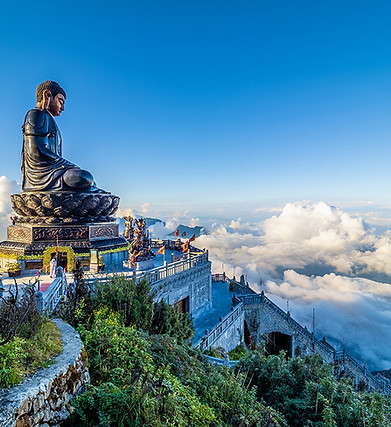
Mount Fansipan in Lao Cai Province, Vietnam. Photographer: Balate Dorin | iStock.
South East Asia
Region: Brunei, Cambodia, Indonesia, Laos, Malaysia, Myanmar, the Philippines, Singapore, Thailand, Timor-Leste and Vietnam
Main international gateways: Bangkok, Singapore, Kuala Lumpur, Ho Chi Minh City, Hanoi, Manila and Jakarta
Best for: Cultural immersion, culinary experiences, ancient sites, tropical landscapes, beaches, wildlife and outdoor adventure
Ideal time to go: November to February generally brings drier, cooler conditions across much of mainland South East Asia, while seasonal patterns differ considerably across equatorial and island destinations.
Getting around: Extensive air networks, trains, buses and ferries, with overland connections between many mainland destinations
Languages spoken: Hundreds of languages, including Indonesian, Malay, Thai, Vietnamese, Filipino, Khmer, Lao and Burmese. English is widely used in major tourism centres.

Swimming with turtles in Moalboal, the Philippines. Image courtesy Lily Mirabito.
Learning to trust your judgement
Briefly …
After travelling solo through much of South East Asia, Lily Mirabito reflects on kindness, vigilance, independence and learning to trust her own judgement. Her experiences reveal a more nuanced understanding of safety and the confidence that comes from learning to make her own judgements.
For Lily Mirabito, travelling alone through South East Asia became an exercise in learning when to be watchful, when to trust and when simply to enjoy where she was. What has stayed with her most is the warmth of the people she encountered and the extraordinary variety of the region itself. Having begun her solo travels in Japan and South Korea because she perceived them as safer choices, Lily gradually came to see safety as something more complex than a destination’s reputation – shaped by awareness, judgement, preparation and the circumstances of each encounter.
Now that you’ve had a moment to step back from the experience of travelling solo throughout South East Asia, what has stayed with you most?
I’ve travelled to almost every country in South East Asia, and the thing that has stuck with me most is the kindness of the locals. They are extremely warm, giving and always wanting to help. I’ve travelled throughout Europe as well and have noticed that the locals throughout South East Asia are far kinder to tourists. They are always smiling.
I was motorbiking in a small village in the Philippines, up in the mountains, where there were children smiling and waving while playing, singing and swimming. They did not have much but were so grateful for what they had. Experiences like this make you more reflective and grateful to have these moments and, in turn, I really felt an appreciation for what was happening in that moment.
Another thing that stayed with me is the versatility of the natural environment. For glorious mountains and incredible sunsets: Vang Vieng in Laos, Sapa in Vietnam, Cameron Highlands in Malaysia and Ha Long Bay in Vietnam. For the hustle and bustle of cities: Phuket and Bangkok in Thailand, Ho Chi Minh City in Vietnam and Singapore. For beautiful beaches and clear waters: Boracay and El Nido in the Philippines, Langkawi in Malaysia and the Phi Phi Islands in Thailand. For the best food: Pai in Thailand, Da Nang in Vietnam, Penang in Malaysia and Lombok in Indonesia. For the best waterfalls: Luang Prabang in Laos and Moalboal in the Philippines.


Clockwise from top left: Hot air ballooning in Vang Vieng, Laos; a sardine run in Moalboal, the Philippines; paramotoring in Vang Vieng, Laos; and hiking in Luang Prabang, Laos. Images courtesy Lily Mirabito.
Solo travel is often framed in broad strokes of “safe” or “unsafe”. How did that idea influence your journey or change for you as you moved from place to place?
I’ve travelled to about 40 countries and have done the majority of that solo. I was apprehensive about solo travel when I first started and began by going to what I perceived as “safer” countries like Japan and South Korea. I had no issues in these countries, and from there I began branching out. What I’ve learnt from travelling independently is that places and experiences are subjective. My main takeaway is to keep your wits about you and, although you may romanticise travelling, keep a level head and remain vigilant.
Were there moments when you felt unexpectedly at ease somewhere you hadn’t anticipated?
On my first solo trip to Japan, I walked into the hostel second-guessing my decision and wondering if I would enjoy myself. I was instantly greeted by fellow solo backpackers and was invited to spend time with them. The atmosphere was far more social and welcoming than I expected. I was also very apprehensive about sleeping in a hostel as I’d only stayed in hotels. I kept my belongings safely secured and had a really pleasant time. A highlight was sleeping in capsule hotels across Japan and Taiwan.
Conversely, were there moments when you felt unexpectedly ill-at-ease somewhere you hadn’t anticipated?
I was in a situation in the Philippines that made me slightly uneasy. I had paid for a five-hour van drive from one island to another. I was promised we would be leaving as soon as possible, but I was left waiting for several hours. The unease came from not knowing when I would leave or whether it was a legitimate van service, but I was more at ease because I was surrounded by fellow travellers.
Some situations I encountered as a solo female traveller made me uneasy, specifically around men – locals and travellers alike. I reduced the risk of these situations by making friends with other female solo travellers and remaining aware of who I was with. When you make travel friends, it’s easy to romanticise them and think you are forming lifelong friendships. While that may be true, it’s always important to remember that you have just met these people and always ensure your safety remains the priority.
Were there places or situations that challenged your sense of safety, and how did you respond?
I found South East Asia quite safe, with very friendly locals. I found other foreign travellers to be more trouble than the locals! Safety was always my priority, and I was always very vigilant when travelling, especially when going to places alone.
“Safety was always my priority, and I was always very vigilant when travelling, especially when going to places alone.”
Travelling alone can heighten awareness in subtle ways. What did you start noticing about your surroundings, and about yourself, as the journey unfolded?
It’s just simple things really: always knowing where your accommodation is, never leaving your belongings unattended if you are out, being cautious about who you interact with and always having your phone charged and a portable charger with you at all times. In Asia, always carry some cash on you, as bank cards and phone payments are not always reliable. It’s fun to enjoy yourself and have new experiences, but my rule of thumb is that if you wouldn’t do it at home, you shouldn’t do it overseas.
How did your relationship with solitude evolve over the course of the trip, particularly across different cultures and environments?
I started to really enjoy time on my own. I felt like I was moving at my own pace and was able to fully appreciate the sights I was seeing. When I did get the urge to chat, I was more inclined to really listen to what people had to say, and I felt I was friendlier than usual and made some really great connections. I didn’t feel any real culture shocks, and I was happy to sit back and take everything in and get a deeper understanding of the countries I was in.
Travelling solo is really freeing and helped with my independence. You have to put yourself out there or you will miss out. In Japan, I attended a traditional onsen by myself. I was so anxious, but I ended up really enjoying myself. Travelling solo strips away your social anxiety or feelings of embarrassment. If I’m walking down a busy street with my 20kg backpack, I might get some stares, but I am on a mission to get to my hostel.
There’s often a narrative that solo travel requires constant vigilance. Did you find moments where you were able to soften that, and simply be present?
If you meet like-minded people on your journey and spend a few days with them, you are able to soften, as you develop a sense of trust in them. Throughout Asia, I felt very safe in temples and religious places. I also hired a lot of trusted guides in Asia, so I felt comfortable on the back of motorcycles with them. I tend to make friends with people staying at the same accommodation and have made friendships that have lasted from three days to more than two weeks.
Looking back across the region, what patterns did you begin to recognise in how different places receive solo travellers – particularly women?
Research is very important, looking up where you are going first and whether you need to keep anything in mind before arrival. It’s also valuable to ask tour guides when you book a religious tour. In South East Asia, it is important to carry a shawl or sarong on you if you come across a temple. Alternatively, if I knew I had a tour booked, I’d wear linen pants and an overshirt to make sure my shoulders and knees were covered. It’s important to be mindful that you are in a very spiritual and sacred place and be aware of your behaviour at these places. Keep your voice down, avoid running or filming anything disrespectfully, and remember that others are trying to enjoy the experience as well or may be using the space to pray. At every religious monument or place I’ve visited, I’ve felt welcomed when I’ve followed the correct protocols.
Tourism is an important source of income across South East Asia, and local people are sometimes too polite to say anything if someone is being rude. I would try to call out poor behaviour when I spotted it. I was also big on tipping in Asia because even though it is perceived as optional, it is fine to tip extra as it can really make a difference in the bigger picture.
For women considering a similar journey, what do you think is most often misunderstood about travelling alone through South East Asia?
I’ve heard two big assumptions about travelling to South East Asia. Firstly, that it is a huge party destination, and while there certainly is a vibrant nightlife, South East Asia has so much more to offer in terms of scenery, cultural experiences and thrill-seeking adventure. I would not travel to Asia – or anywhere for that matter – with the sole purpose of partying because you’ll risk missing out on so much of what it has to offer.
The second is that you will get sick from the food. I think it is a judgement call. If you think something is not right, then don’t eat it, but don’t disregard something if it is street food or from a market. I also did not know how to ride a motorcycle and did not want to drive myself, so booking a tour was helpful. As I was a solo traveller, it was just me and a driver. Sitting on the back of a motorcycle gave me a lovely view of scenery I might never otherwise have seen.
Can you share your top 3 tips for successful solo travel?
1. Do things that you want to do. The whole point of solo travel is to find out what you enjoy, so don’t do something just because people in the hostel are doing it or you saw it on TikTok. Just go at your own pace.
2. Learn a few simple phrases in the local language that will help you when asking for help. You may not be perfect, but locals appreciate the effort.
3. It’s OK to have rest days. I used to feel so guilty being in a foreign country and wanting to just rest, but you are moving very quickly and have a lot on your mind. It’s better to take a rest day so you don’t get burnt out.