
THE SOLO TRAVELLER
Your world. Your way.
Risk, Readiness and Respect – A Confidence and Safety Series

Tarik J from Samra Voyages. Image courtesy Samra Voyages.
What the mountain teaches
A Q&A with Tarik J from Samra Voyages
Briefly …
Over nine years guiding hikers in Morocco’s Atlas Mountains, Tarik J has watched the same patterns emerge time and again. In this conversation, Tarik shares what solo travellers most commonly underestimate about Mount Toubkal, why preparation matters more than confidence, and how the mountain often reveals far more than physical endurance alone.
Mount Toubkal attracts solo travellers from around the globe seeking a challenge. At 4,167 metres above sea level, North Africa’s highest peak offers a demanding but accessible trek for those prepared to meet it on its own terms. Yet as this conversation reveals, the mountain itself is only part of the story.
Guiding hikers in Morocco’s Atlas Mountains, Tarik J has watched thousands of hikers arrive with different levels of experience, confidence, fitness, and expectation. Again and again, he has observed the same patterns emerge. Strong hikers struggle with altitude. Nervous first-timers succeed through preparation. Fear grows from uncertainty, while good information changes everything.
What emerges throughout our conversation is a simple but powerful distinction: Toubkal is a challenge destination, not a risk destination. The mountain rewards preparation, patience and respect. It exposes assumptions, reveals strengths and limitations, and often teaches lessons long before hikers reach the summit.
“One piece of advice I give consistently that people hear but don’t fully absorb: save energy for the descent. Most accidents on Toubkal happen on the way down, not on the way up. Legs are tired, concentration drops, and the terrain stays exactly the same. The ascent is a choice. You can stop, turn back. The descent is an obligation.
“The ascent is a choice. You can stop, turn back. The descent is an obligation.”
What helps is that the summit changes something. You come down carrying an accomplishment that wasn’t there before. Your legs hurt but your head is different. A lot of people cry on the way back down. Not from exhaustion, but from realisation. That’s often when the experience actually lands.
Something I’ve learned in nine years is that a good guide is not a GPS, he’s a psychologist. The mountain is marked. What a guide actually manages is the mental side – the doubt, the fear, the fatigue that speaks louder than the body. That’s why choosing the right guide matters as much as choosing the right boots.
Toubkal is a little like a doctor. It reveals your mental strength and your physical capacity. It introduces you to the feeling of real accomplishment, the ability to push past what you thought was your limit. It shows you the strength in your legs, the resilience in your back, the strange pleasure of forgetting difficulties by walking through them. And it makes you think differently about your projects, your fears, your limits, long after you’ve come back down.
It’s not just a mountain. It’s an experience that stays with you.”

Hiking to the village of Tacheddirt, near Marrakech, Morocco, where the views of the majestic Atlas Mountains are breathtaking. Photographer: M Ed | Unsplash.
Many solo travellers are drawn to Mount Toubkal for the sense of achievement, but what do people most commonly underestimate about the physical and mental demands of the trek?
Most people train for distance. Barely anyone trains for altitude. Hiking “4,000 metres” sounds like a distance, but it isn’t. You’re climbing to 4,167 metres above sea level. Your legs might feel fine. Your lungs won’t. The cold catches people off guard every time, and many show up with the wrong clothing. Imlil – a small village in the Atlas Mountains of Morocco – sits at 1,800 metres above sea level. In spring, the village feels comfortable, and in summer it can feel almost warm. Three hours up the trail, above 3,000 metres, that’s no longer the case. The body burns more energy simply maintaining its temperature.

Imlil, Morocco. Photographer: Louis Hansel | Unsplash.
Then there’s the “I’ve done mountains before” problem. Toubkal isn’t technical, but it is specific. Loose terrain, steep sections, and narrow passages demand focus when you’re already tired. Experience elsewhere helps, but it doesn’t transfer completely. I’ve seen confident hikers struggle more than nervous first-timers because they stopped paying attention.
Mental preparation is underrated. When your heart rate climbs, your legs go heavy, and your breathing feels wrong – and it will feel wrong – what you do in that moment decides everything. Hikers who have thought about it in advance usually manage well, but those who haven’t tend to spiral.
The refuge night catches people out in both directions. Skip it and you compress everything into one brutal day. Stay there and you discover that sleeping at 3,200 metres doesn’t always mean resting properly. You leave at 5am already tired, and that’s before the hardest section.
One final thing: dehydration. At altitude, the body stops signalling thirst reliably. Most people arrive at the refuge already behind on water without realising it. By the time the summit push starts, the headache and fatigue are already there.
You mention that cold conditions above 3,000 metres often catch hikers off guard. What does proper preparation actually look like for someone attempting Toubkal for the first time?
Proper preparation for Toubkal comes down to four things: fitness, gear, logistics, and timing. As far as fitness is concerned, the priority is cardio and endurance, not strength. Start six to eight weeks before the trek. Long weekend hikes with a loaded pack, stair climbing, and anything that builds sustained effort over time will help. The goal is to be comfortable breathing hard for four to six hours straight. A test hike in the mountains beforehand is worth doing. It shows you how your body reacts to elevation and helps break in your boots before it matters.
Gear and clothing choices are critical. The three-layer system works well – a breathable base layer, a warm mid layer, and a windproof outer shell. What people often get wrong is the fabric. Heavy jackets and thick cotton layers feel fine in Imlil but become a problem above 3,000 metres. They get heavy, absorb sweat, and leave you caught between wanting to take them off and needing to keep them on because of the cold. Clothing designed specifically for trekking manages temperature and moisture much better, and the difference is noticeable, not just theoretical.
Proper mountain trekking boots are essential, and they should be well broken in before the trek. Slightly larger sizing can help accommodate thicker socks and protect your toes on the long descent. No specific brand is necessary. Fit and preparation matter more than the label.
From a logistics perspective, I always recommend sleeping in Imlil the night before. Don’t skip this. There are two refuges at around 3,200 metres, and both are adequate. I also recommend bringing your own sleeping bag for comfort and hygiene. The refuges provide blankets, but most experienced trekkers prefer not to rely on them.
Water is another area where people underestimate what they need. The standard advice is to carry two to three litres for summit day. I tell my clients to carry five. At altitude, dehydration accelerates and thirst signals become less reliable. Running out of water on the upper section is not a situation you want to manage.
Timing matters as well. May to June and September to October are the standard windows for a first attempt. Personally, I find March ideal. The mountain is quieter, temperatures are manageable, and the light is different. Summer is certainly possible, but the heat in the valley before you gain altitude can be draining. Winter is a completely different expedition. You need crampons, an ice axe, and the ability to deal with temperatures below –10°C at night. In those conditions, it is not a mountain for first-timers.

Mount Toubkal. Photographer: David Magalhães | Unsplash.
Vertigo and exposure can affect even experienced hikers differently. How do guides help solo travellers manage fear, fatigue, and decision-making on the mountain?
Vertigo on Toubkal usually appears in the same place: the scree section on the final approach, where the ground is loose and the exposure becomes real. It’s not technical terrain, but when you’re already tired and the drop is visible on both sides, something shifts. Even experienced hikers can freeze.
The physical response is predictable. The eyes widen, the breathing shortens, and the body wants to stop. What a guide does in that moment is simple and specific: don’t look at the drop. Fix your eyes on a point two metres ahead. Shorten your steps. Control your breathing. Most vertigo on Toubkal is a focus problem, not a physical one. Redirecting attention breaks the spiral almost every time.
But a good guide doesn’t wait for vertigo to arrive. The real work happens much earlier – often in the first hour on the mountain, and sometimes the night before at the refuge. The questions that come up on Toubkal are rarely about the route itself – “I can’t catch my breath. Is that dangerous?”. “Why is my heart beating this fast?”. “If I’m exhausted now, how am I going to make it back down?”.
A guide who has prepared a hiker for these sensations changes everything. When breathlessness arrives at 3,500 metres, the hiker recognises it instead of panicking. The guide has already explained: this is normal, this is what altitude does, this is not your body failing.
Something I have seen many times is people crying on the mountain and not being able to explain why. They’re not in pain, and they’re not frightened. The mountain is just doing what it does. It educates.
The decision to turn back is often the hardest call. A good guide presents it as protection, never failure, and makes that decision early – before the descent becomes dangerous. On Toubkal, most accidents happen on the way down. There’s no helicopter. Everyone walks down.
There is sometimes a perception that solo female travellers may face additional challenges in remote mountain regions. From your experience guiding in the Atlas Mountains, how do local guides help create a safe and supportive environment?
This question deserves an honest answer, not a reassuring one by default. The Atlas villages – Imlil, Aroumd, and the smaller hamlets around them – function like tight-knit communities in the best sense. Everyone knows each other, and tourism is the primary source of income. The local population understands that. There is a collective investment in maintaining a safe environment. Nobody benefits from an incident, and that shared understanding creates something genuinely protective. In my experience, it is one of the rare places where local risk is as close to zero as it gets.
Where a guide makes a concrete difference is socially, not just logistically. A woman arriving alone in a village without local accompaniment is an unknown quantity. A woman arriving with a local guide is introduced. She has context, a recognised connection, and a point of reference that the community trusts. In a culture where relationships are built through intermediaries and established trust, that distinction matters more than it might seem from the outside.
The unknown isn’t the local population – it’s other hikers passing through, who are unknown quantities just as they would be anywhere else. No one can offer an absolute guarantee about that, and pretending otherwise would be dishonest. That risk exists on trails everywhere, not specifically in the Atlas.
What I tell women who ask me directly is this: the Atlas is among the safest environments I know for a solo female hiker travelling with a local guide. Not because it is risk-free – nowhere is – but because the community structure, social fabric, and local support create conditions that are genuinely favourable.
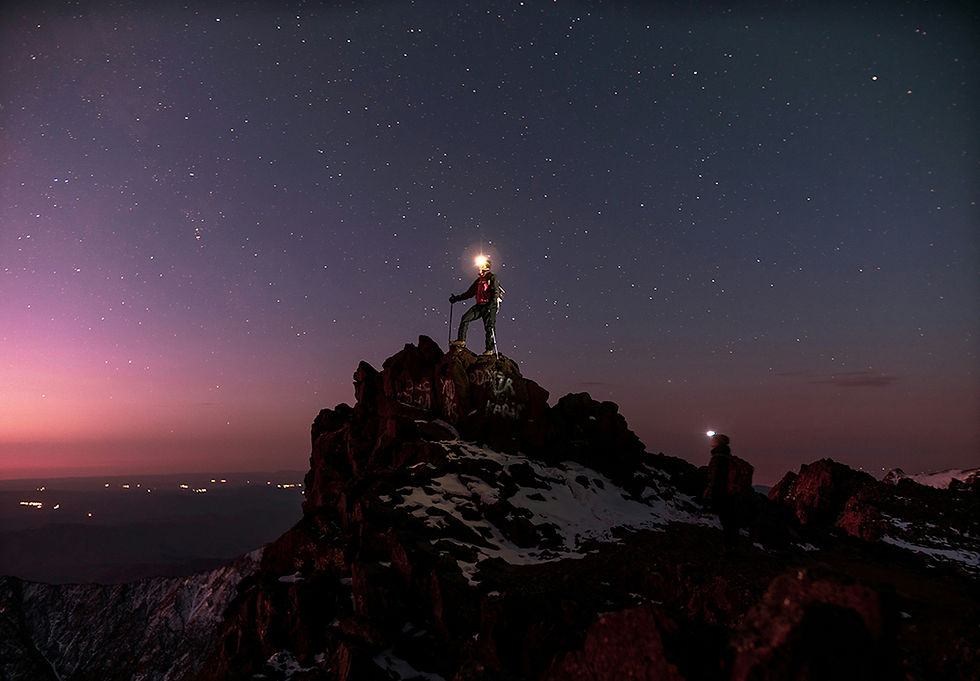
Mount Toubkal, Morocco. Photographer: Mads Schmidt Rasmussen | Unsplash.
You describe the Atlas Mountains as “a challenge destination, not a risk destination”. What do you hope solo travellers understand about that distinction before they arrive in Morocco?
The distinction matters, and it changes everything about how you approach the mountain. Risk is something outside your control. Challenge is something you can prepare for, anticipate, and manage. Toubkal belongs in the second category. There’s no glacier, no technical climbing, and no sections that require ropes. It’s a marked trail to the summit. The altitude is real, the cold is real, and the terrain is demanding. But none of these elements are uncontrollable. They are variables you can address in advance through preparation and proper support.
What turns a challenge into a danger isn’t the mountain. It’s a lack of preparation. Someone who arrives without cardio training, without the right gear, and without spending a night in Imlil to acclimatise is taking a real risk. Not because Toubkal is dangerous, but because they haven’t respected what the mountain requires.
Over the past 12 years, I’ve seen people in their 50s and 60s, with no previous high-altitude experience, reach the summit because they prepared properly and trusted the guide’s pace. I’ve also seen experienced hikers turn back because they underestimated the altitude or pushed too hard too early.
The mountain is the same for everyone. What changes is what you bring to it.
What I want travellers to understand is that fear of Toubkal usually comes from a lack of information, not from actual danger. When you know what to expect – physically, mentally, and logistically – the mountain becomes what it really is: an accessible challenge, not a gamble.
You can connect with Tarik via his website here https://www.samra-voyages.com, and learn more about Tarik’s guided treks of Mount Toubkal here https://www.samra-voyages.com/travel-guide/hiking-in-morocco-from-marrakech