
THE SOLO TRAVELLER
Your world. Your way.
Field Notes

The Bounty in The Pitcairn’s Island Register. Image courtesy Norfolk Island Tourism.
The Bounty record returns to Norfolk Island
By Tiffany West
Briefly …
A handwritten register documenting the lives, conflicts, births and survival of the Pitcairn Island community descended from the HMS Bounty mutineers has arrived on Norfolk Island, returning a foundational record of ancestry and identity to the descendants of those it chronicles.
More than 170 years after it left the Pacific for England, the Pitcairn’s Island Register has arrived on Norfolk Island for the first time – not simply as a museum artefact, but as a document deeply entwined with the identity of the island’s people.
The handwritten volume, on loan from the UK’s National Maritime Museum to the Norfolk Island Museum Trust for three years, records births, marriages and deaths on Pitcairn Island from 1790 to 1854. For the descendants of the HMS Bounty mutineers and their Polynesian wives, many of whom now live on Norfolk Island, it is regarded not as distant history but as a living record of origin.
The arrival coincides with the 170th anniversary of Bounty Day on 8 June, the annual commemoration marking the arrival of the Pitcairn Islanders on Norfolk Island in 1856 after the population of the tiny Pacific island outgrew its resources. Today, more than a quarter of Norfolk Island’s population can trace its ancestry directly to the people named in the Register.
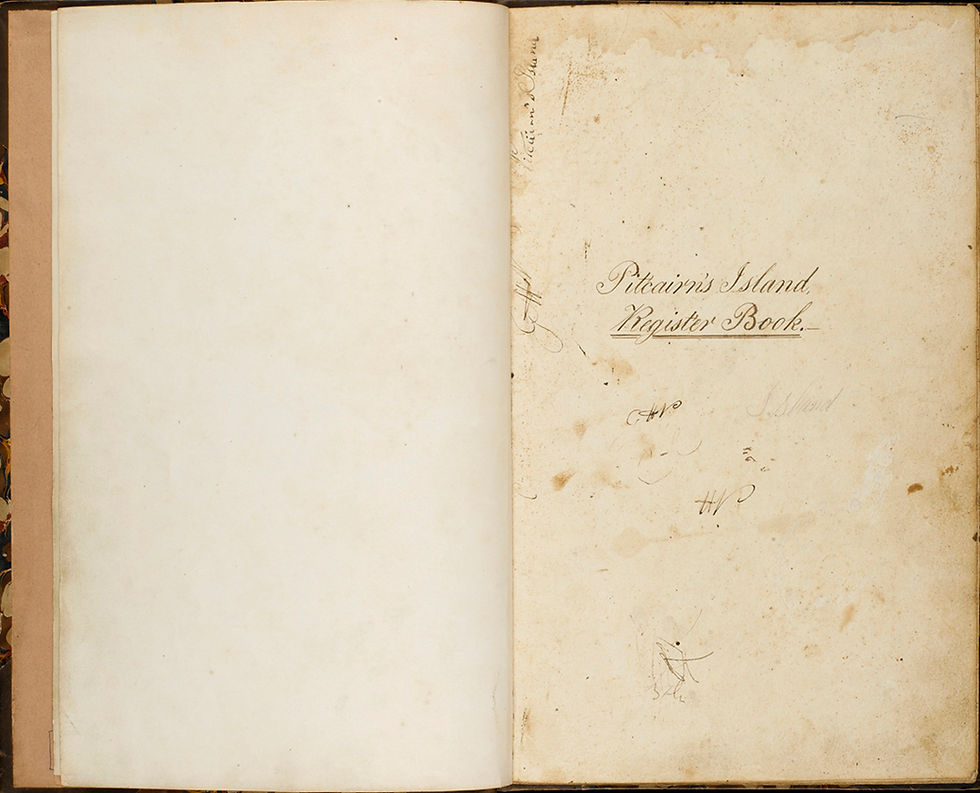
Pitcairn’s Island Register Book. Image © Courtesy National Maritime Museum, London.
Among its earliest entries is a reference to Thursday October Christian, the first child born on Pitcairn Island and the son of lead mutineer Fletcher Christian and his Tahitian wife Mauatua. But the Register documents far more than lineage. Drawing partly on the testimony of surviving mutineer John Adams, it records the turbulent and often violent reality of life on Pitcairn after the mutiny. There are references to killings among the mutineers and Polynesian men in 1793, the island’s first alcohol distillation in 1798, and an attempted murder involving Matthew Quintal in 1799.
The volume also preserves traces of equally revealing moments, including an account of Polynesian women attempting to escape the island in 1794. The commentary accompanying the event reflects the paternalistic attitudes of its era, describing the women as “ignorant” and questioning how they could survive alone at sea – language that now offers its own insight into the worldview of the time.

Kingston Pier, Norfolk Island. Image courtesy Norfolk Island Tourism.
Helen Mears, Head of Curatorial at the National Maritime Museum, described the Register as “a unique historical document” that captures the resilience and resourcefulness of the community formed after the mutineers landed on Pitcairn Island in 1790. For Norfolk Island, however, the significance is more personal than institutional. Dr Pauline Reynolds, Chair of the Norfolk Island Museum Trust and herself a descendant of the mutineers, their Polynesian wives and the Register’s authors, called it “a foundational document of our people”, describing it as “awas kamfram” – “our origins”.

The view of Norfolk Island from the Queen Elizabeth Lookout. Image courtesy Norfolk Island Tourism.

An aerial view of Norfolk Island’s ‘new’ gaol. Image courtesy Norfolk Island Tourism.
For solo travellers visiting Norfolk Island, the story adds another layer to a destination already shaped by isolation, migration and memory. Beyond its dramatic coastline and subtropical calm lies a community whose history is unusually traceable – written not only in museums and archives, but in surnames, traditions and family connections that remain visible across the island today.
To learn more about the Norfolk Island Museum Trust, visit their Facebook page here. You can also learn more about the UK’s National Maritime Museum on their website https://www.rmg.co.uk/national-maritime-museum
Tiffany West is The Solo Traveller’s Editorial and Pictorial Assistant Lead.