
THE SOLO TRAVELLER
Your world. Your way.
The Changing Map
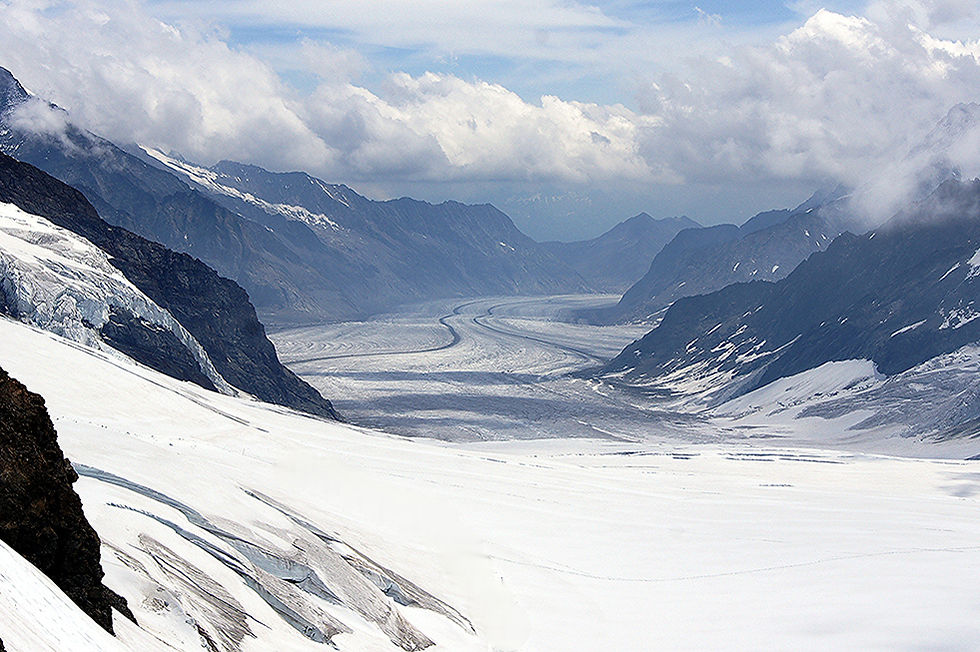
The Great Aletsch Glacier, Switzerland. Photographer: Eduardo Cabanas | iStock.
Where ice once reached
By Josh Chandler and Geoffrey Williams
Briefly …
Switzerland’s glaciers lost more than five per cent of their remaining ice in 2026, exposing rock, expanding lakes and increasing the distance between familiar approaches and the glaciers they were built to reach. What does it mean for travellers when returning to the same viewpoint no longer means returning to the same view?
There are places where a changing landscape can still be measured in centimetres. In the Swiss Alps, metres are becoming the more useful unit. Switzerland’s glaciers lost more than five per cent of their remaining ice volume during 2026. Across individual glaciers, average thickness fell by between 2.5 and four metres. On some glacier tongues, as much as ten metres of ice disappeared over the summer.
For travellers returning to the Swiss Alps, these losses are becoming increasingly difficult to regard as changes occurring somewhere beyond the places they visit. Around 1.1 million people use the lifts each summer to reach the three main viewpoints overlooking the Great Aletsch Glacier. These are not remote landscapes beyond our gaze – they are heavily visited mountain environments.
At the Great Aletsch Glacier and Rhône Glacier – two of the country’s most recognisable glacial landscapes – 2026 produced the greatest melt since measurements began. At the Rhône Glacier, the retreat of the ice has already changed a long-established visitor experience. The artificial ice grotto near the Furka Pass, which attracted up to 100,000 visitors a year, had become detached from the glacier itself and was being maintained beneath protective covers. Its operation was abandoned in 2026 because the remaining block of ice had become too small.
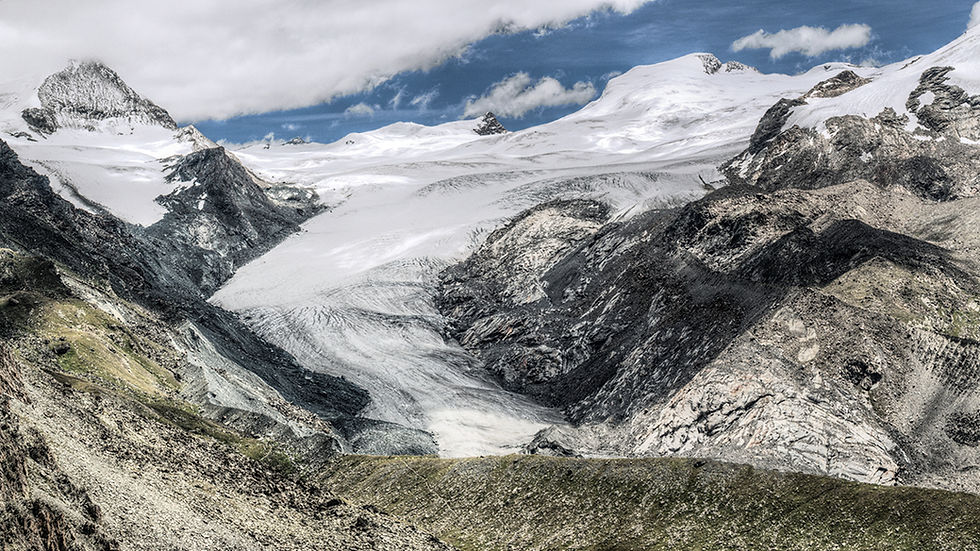
The Findel Glacier. Photographer: Elliott Bignell | iStock.
Around the Findel Glacier near Zermatt, retreating ice is exposing an expanding landscape of lakes and scree. Elsewhere, the change is more definitive. The Bella Tola Glacier in Valais and Griessfirn/Plattalvafirn in Glarus are among the small Swiss glaciers now considered to have disappeared. They are individual changes within a much larger loss: almost 20 per cent of Switzerland’s glacier volume has disappeared in just five years.
The scale of the 2026 melt began well before summer. Winter 2025–26 was among the ten least snowy recorded in Switzerland. Snow depth was well below the long-term average at every elevation monitored, leaving glaciers with less of the seasonal covering that ordinarily protects the ice beneath during warmer months.
An unusually persistent warm season followed. Every month from May through September brought dry conditions and at least one heatwave. During those five months, the freezing level rose above 4,000 metres on 76 days – more than twice the average and the highest number recorded. By September, snow had disappeared even at elevations of 3,500 metres.
The result was Switzerland’s second most severe year of glacier loss after 2022. At the Allalin, Clariden, Aletsch and Rhône glaciers, however, the losses surpassed those of 2022 and established new individual records. For travellers in the Alps, those measurements describe something more tangible than a national percentage.
The Great Aletsch Glacier offers perhaps the clearest scale on which to understand what is happening. The largest glacier in the Alps, Aletsch can appear almost permanent: a vast river of ice curving through the mountains below Jungfrau, Mönch and Eiger. Glacier Monitoring Switzerland (GLAMOS) measurements at Konkordiaplatz now record continuing losses in the thickness of that ice, with the changes of the past few years particularly pronounced.
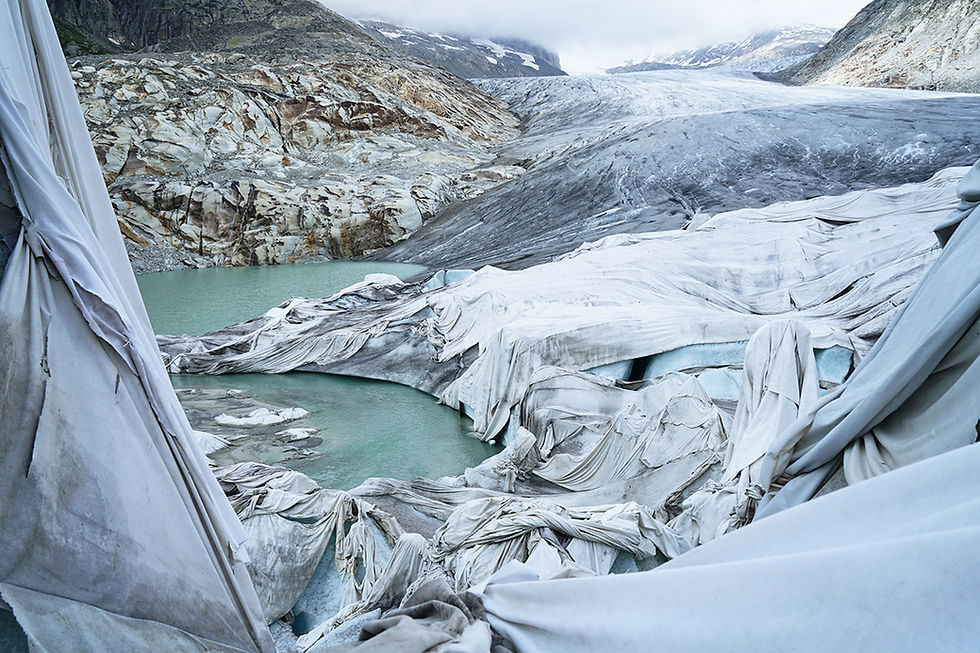
Protective sheets cover part of the Rhône Glacier in an attempt to slow summer melting. Photographer: MikeDot | iStock.
The Rhône Glacier tells the same story differently. Its retreat is creating a new landscape in front of it. Water occupies some of the space once filled by ice, while the glacier itself withdraws farther from the landscape through which generations of travellers have approached it. This does not mean Switzerland’s glacier landscapes are about to disappear from a traveller’s itinerary. The larger glaciers remain enormous, and the Alps remain one of the great mountain environments of Europe. It does mean that returning to the same viewpoint no longer necessarily means returning to the same view.
“… returning to the same viewpoint no longer necessarily means returning to the same view.”
There is another change occurring less visibly downstream. Between July and September 2026, Swiss glaciers released around 2,200 billion litres of water as ice and snow melted – more than four times the annual drinking-water consumption of Swiss households. During hot, dry summers, that water can help maintain rivers and compensate for periods of low rainfall.
The apparent abundance disguises a problem. Researchers comparing 2026 with the exceptionally hot summer of 2003 found that, despite higher rates of melting, the glaciers released less water in 2026 because there is now less ice available to melt. “The ice lost today will no longer be available to us as meltwater in the future,” GLAMOS glaciologist Andreas Linsbauer says. The consequences extend beyond the glaciers themselves to water supplies, hydropower, agriculture and ecosystems.
In the mountains, the more immediate evidence requires no modelling. It is visible in exposed rock, expanding lakes, abandoned ice attractions and the growing distance between old approaches and the ice they were built to reach. The Swiss Alps remain the Swiss Alps, but increasingly, visiting their glaciers also means watching a new landscape emerge as the ice retreats.
Sources
Huss, M., Bauder, A., Linsbauer, A., and Barandun, M. (2026). Annual mass balance on Swiss glaciers in 2025/2026. GLAMOS.
Kusma, S. (2026). The Swansong of the Glaciers. Swiss Federal Institute for Forest, Snow and Landscape Research.
Salim, E., Ravanel, L., and Bourdeau, P. (2023). Glacier tourism without ice: envisioning future adaptations in a melting world. Frontiers in Human Dynamics, 5.
SWI swissinfo.ch. (2026). Swiss Rhône Glacier ice cave ordered closed.
University of Zurich. (2026). Swiss glaciers lose a further five per cent of their volume. Department of Geography.