
THE SOLO TRAVELLER
Your world. Your way.
Tools and Tech
Photographer: Antonio Diaz | iStock.
Can an app beat jet lag?
By Simone Baxter
Briefly …
Jet lag has never cared that we have places to be and things to see. An app says it can help reset our internal clock, so we took a look at the science because apparently stubbornly staying awake until bedtime is not a strategy.
There is something particularly insulting about jet lag when we travel alone. We have negotiated the airport, survived the long flight and finally arrived somewhere we wanted to be, with nobody else’s plans to accommodate and complete freedom to decide what happens next. Unfortunately, our bodies have other ideas.
At three in the afternoon we want to sleep. At three in the morning we are ready for breakfast. And our internal clock remains stubbornly attached to somewhere thousands of kilometres away. Even though travelling solo gives us an unusual amount of control over what we do when we arrive, jet lag has never shown much respect for our fiercely defended independence. We treat it as an unavoidable consequence of long-haul travel, accompanied by a collection of familiar remedies: drink water, avoid alcohol, sleep on the plane, stay awake until bedtime when you arrive and get outside as soon as possible. Some of that is useful, but some of it misses what jet lag actually is.
The US Centers for Disease Control and Prevention (CDC) describes jet lag disorder as a temporary mismatch between our internal biological clock and local time after rapid travel across time zones. The consequences can include disturbed sleep, daytime sleepiness, impaired concentration, general malaise and gastrointestinal problems. Travelling east is generally harder to adjust to than travelling west because advancing our internal clock is more difficult than delaying it. For some reason.
Our circadian rhythm is the roughly 24-hour internal cycle that helps regulate when we feel awake and when we become sleepy, along with changes in body temperature, hormone production, digestion and other bodily functions throughout the day. It is kept aligned with the outside world largely by environmental cues, particularly light. Crossing several time zones quickly does not immediately reset that internal clock, which is why we can arrive in the morning while our body is still behaving as though it is the middle of the night.
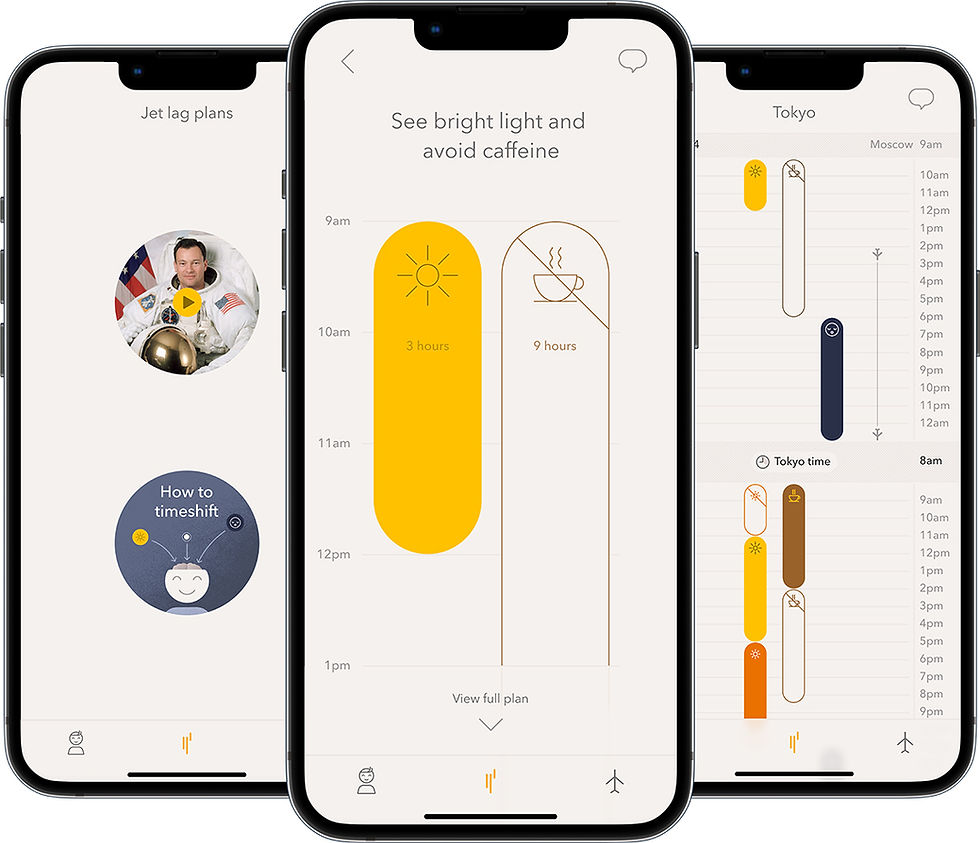
Image courtesy Timeshifter.
That mismatch is the problem Timeshifter, a jet lag management app drawing on established circadian science, proposes to tackle. Enter your flights, normal sleep pattern and some personal information and it produces a timetable telling you when to sleep, seek or avoid light and use or avoid caffeine.
Light is one of the principal signals our bodies use to set the internal clock, but more daylight is not necessarily better. Exposure at an appropriate time can help move the biological clock towards destination time. At the wrong time, it can move it in the opposite direction. That makes the perennial advice to get outside after arrival rather less straightforward than it sounds. Depending on where you have travelled, the direction you have flown and what time your body thinks it is, avoiding light can sometimes be as important as seeking it.
A systematic review of non-pharmacological jet lag interventions (things that do not require an exhausting and expensive trip to the chemist) found surprisingly limited evidence from air travellers themselves. Of 13 studies examining approaches including light, exercise and diet, nine found no significant improvement, three produced mixed results and one was positive. The researchers pointed to weaknesses in the way many interventions had been designed and to another complication we easily overlook – ‘travel fatigue’ and ‘jet lag’ can arrive together, but they are not the same thing.
“… ‘travel fatigue’ and ‘jet lag’ can arrive together, but they are not the same thing.”
This is where an app begins to earn its place in the conversation. Most travellers have little need to understand phase advances, phase delays or the intricacies of the circadian clock while trying to remain alert (and vertical) in an arrivals hall. Timeshifter attempts to turn the calculation into instructions, and while recent independent accounts suggest that can be useful, following those instructions while travelling is another matter.
Washington Post travel reporter Natalie B Compton used Timeshifter on two recent trips to Europe and reported considerably milder jet lag than she had previously experienced, despite not following every instruction precisely. Matt Jancer, testing the app for VICE on a New York to Amsterdam journey, gradually moved his bedtime before departure and arrived without the nausea and fatigue he had experienced on previous trips. Other experiences reveal the practical limitations. Testing Timeshifter during a 15-hour journey, Travel Bulletin’s Abbey Hudetz found prescribed sleep, light avoidance and naps could be difficult to reconcile with the realities of flying, working and reaching her accommodation.
That tension is perhaps more interesting than whether a reviewer felt better after landing. The science operates according to a clock. Travel rarely does. Travelling solo, though, removes at least some of those complications once we arrive. There is no negotiation over breakfast, an afternoon nap or whether everybody really needs to stay awake for dinner. If the useful part of a personalised jet lag plan is the ability to act at particular times, the solo traveller may be unusually well placed to do it.
“The science operates according to a clock. Travel rarely does.”
There is no secret physiological switch available only to Timeshifter users. A traveller who understands circadian timing could devise a schedule for changing sleep, seeking and avoiding light and managing caffeine. The CDC provides much of the underlying guidance: adjust sleep towards destination time before departure if practical, time activities during the flight around the destination, use natural light strategically after arrival and avoid long daytime naps.
Independent accounts of Timeshifter are encouraging, and the company has plenty of evidence from its own users. Based on 129,852 post-flight surveys, Timeshifter says 96.4 per cent of travellers who followed its advice did not experience severe or very severe jet lag. That is an impressive number, although the results are based on Timeshifter’s own user surveys rather than an independent clinical trial of the app. What Timeshifter does expose is the weakness in some of the advice we have been carrying around airports for years. Jet lag is not simply tiredness to be defeated with water, determination and a heroic refusal to go to bed before 9 pm. Our internal clock has been left behind and persuading it to catch up depends on when we sleep, when we see daylight and when we reach for the coffee.
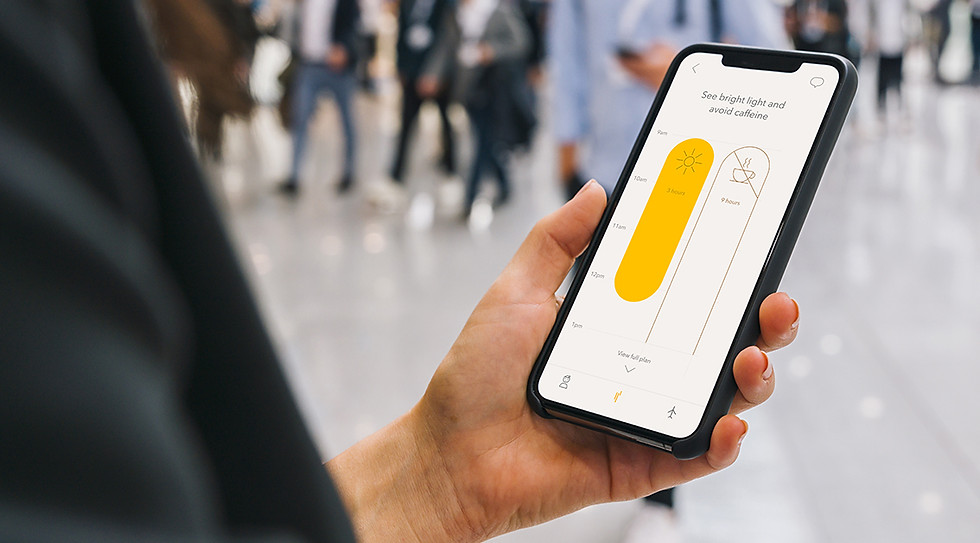
Image courtesy Timeshifter.
That does not necessarily require an app. But after a long-haul flight, when your body believes it is midnight, your destination insists it is breakfast time and somebody has finally handed you the keys to a hotel room with very effective curtains, knowing whether to open them may be rather useful.
Editor’s note: For the record, Simone has not tested Timeshifter herself. Her jet lag remains resolutely familiar and mostly unmanaged.
Sources
Bin, Y., Postnova, S., and Cistulli, P. (2019). What works for jetlag? A systematic review of non-pharmacological interventions. Sleep Medicine Reviews, 43.
Compton, N. (20 May 2026). The app that helped me manage my jet lag. The Washington Post.
Hudetz, A. (2026). Astronauts helped build an app that promises to beat jet lag. Travel Bulletin.
Jancer, M. (7 February 2026). This app claims to eliminate jet lag. I tried it to see if it works. VICE.
Lockley, S. (2026). Jet lag apps, calculators and remedies compared. Timeshifter. Accessed 6 October 2026.
Riedy, S., and Williams, S. (2025). Jet lag disorder. CDC Yellow Book 2026: Health Information for International Travel. CDC.