
THE SOLO TRAVELLER
Your world. Your way.
Learning and Creativity
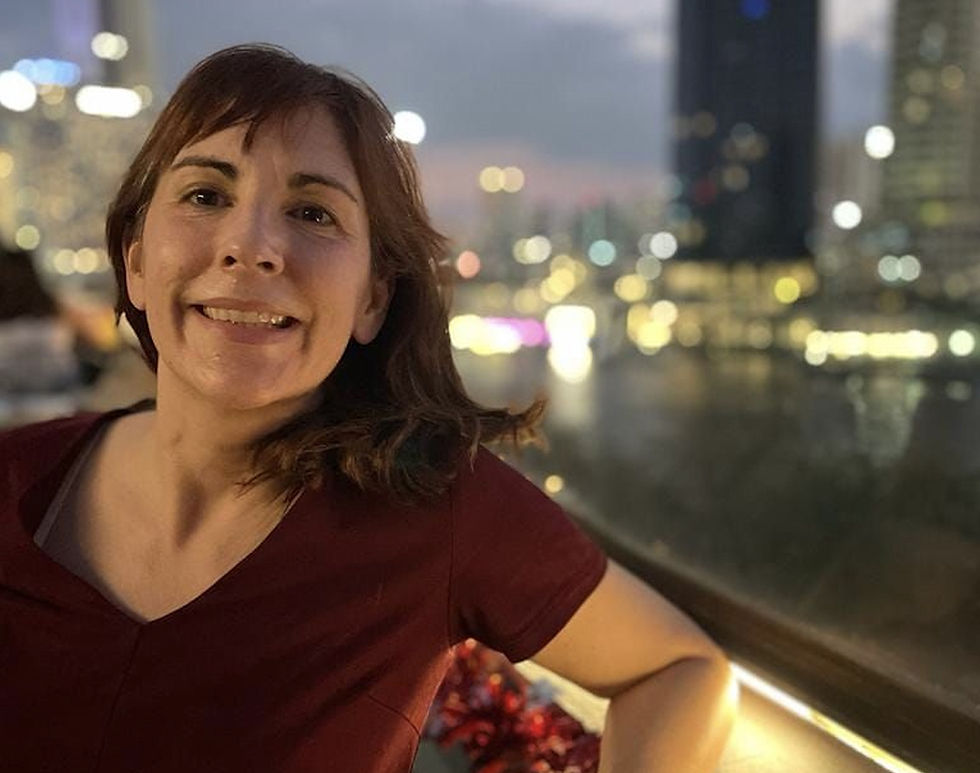
Jillian in Bangkok, Thailand.
Crafting your travel memoir
Jillian Schedneck in conversation with Geoffrey Williams
Briefly …
Author, travel memoirist, and writing teacher Jillian Schedneck reflects on the craft of travel memoir – from shaping lived experience into narrative, to balancing scene and meaning, and why solo travel so often provides the raw material for lasting, transformative stories.
Writing a travel memoir isn’t about ticking off destinations or retelling events. It’s about finding the deeper meaning beneath the surface of experience – the small moments, the unexpected tensions, the personal shifts that transform a journey from a series of days into a story worth sharing with the world.
Jillian Schedneck found this truth early on, learning to observe and write about the ordinary and the difficult with equal care. Solo travel, she says, often unlocks those moments, offering challenge and clarity that fuel a memoir’s emotional core.
What first made you realise you wanted to write your travel memoir? Was there a particular moment or journey when you thought ‘This belongs on the page’?
What first made me want to write a travel memoir was reading travel memoirs. I fell in love with the genre, especially stories by young women who moved abroad. I loved how those books often ended with the author forming deep and complicated relationships with the people and the place. I wanted that kind of transformation, and I wanted to write about it so others might be inspired. Some of the memoirs that shaped me were The House on Dream Street by Dana Sachs, The Woman Who Fell from the Sky by Jennifer Steil, and Grammar Lessons by Michele Morano. There are many more.
When I moved to Abu Dhabi at twenty-six, I already had the intention to write about it. In those first weeks, while waiting for my housing to be ready and my university teaching job to begin, I would walk the city streets in the evening once the intense heat had faded. I remember scolding myself for not making something more ‘exciting’ happen, something that felt worth writing about. Eventually I realised that what I was already doing – wandering an unfamiliar city and trying to buy basic things for my new apartment was the adventure. Everything was new, and I kept overlooking that.
“Eventually I realised that what I was already doing – wandering an unfamiliar city and trying to buy basic things for my new apartment was the adventure.”
To reorient myself, I reopened some of my favourite travel memoirs and was reminded of how compelling everyday activities could be on the page. It was all in how the writer observed and reflected on the ordinary, so I started writing about those small moments. As I met more people and settled into my job, the tension, drama, and confusion arrived on their own. By the time I finished the first half of my memoir, it was already book-length. I had experienced so much that I had to cut back significantly.
Even though I always intended to write about my time in Abu Dhabi and Dubai, there was one particularly negative moment that confirmed it. My employer took my passport, and for a while I didn’t know if I’d get it back in time for a planned trip to a wedding in Paris. It was incredibly stressful, yet even then a small part of me noted how dramatic this was, and that I would write about it. Writing gives an upside to difficult travel experiences. Most of us secretly know that once something negative like that is behind us, it might become a great story.
How did your own travels influence your decision to create a step-by-step guide for others?
My love of travel memoir shaped my solo travels and my writing, and over time it also turned me into a student of the form. I devoured travel memoir anthologies from Travelers’ Tales, such as their ‘Best Travel Writing’ series, and ‘The Best American Travel Writing’ (sadly now defunct), as well as online magazines dedicated to personal travel stories. I loved those tidy arcs of adventure and growth in unfamiliar places. The more I travelled, the more I paid attention to which parts of my trips might form a compelling narrative arc of my own.
After publishing my memoir, I wanted to share what I had learned. When I lived in Adelaide, I was part of the South Australian Writers Centre and was lucky to teach travel memoir classes there. In preparing those workshops, I noticed two things: Australians have travelled widely and really want to write about it, and I could draw on the basic narrative patterns I’d absorbed from years of reading the genre. I eventually shaped these ideas into four key steps in the travel memoir writing process, useful for shorter pieces and full-length books.
When I moved to Canberra and had fewer in-person teaching opportunities, I learned how to design and host online courses. I created a comprehensive travel memoir writing course and later gathered and reworked that material into a single guidebook Write Your Travel Memoir: A Step-by-Step Guide.

Dubrovnik, Croatia. Photographer: Ivan Ivankovic.
What were the biggest challenges in turning memories and experiences into a clear, usable guide?
The biggest challenge is finding the deeper meaning of the journey. It takes reflection to understand why a certain moment stayed with us, and that kind of looking inward can be uncomfortable or simply unfamiliar.
For example, I recently wrote about a bus ride from Dubrovnik to Kotor. It’s memorable because a planned two-hour trip stretched into ten, but I didn’t want to focus only on the inconvenience. I was rattled in a way that felt larger than the situation, and I tried to understand why. Most of the other passengers were twenty-somethings who seemed completely unfazed. Seeing them, I reflected on my encounters with people their age on that trip and at home, noting my mix of envy for their youth and irritation at their lack of discretion. Their behaviour reminded me of the students I teach in Australia, which helped me understand that my tension came from recognising a familiar energy I both admired and found frustrating. Without letting that backstory overwhelm the piece, I wove in these reflections to show why the moment felt bigger than just a long, unpleasant bus ride. That search for meaning became the spine of Passage to Kotor.
The main challenge in writing my travel memoir guide was translating my course material into text that would be easy to follow on the page. I wanted the voice to feel conversational and encouraging, the way I teach in person. I imagined a room full of seasoned travellers with great stories but unsure how to shape them, so I broke the process into a few clear steps. Then I broke those steps down even further, because most people find multiple examples and angles of explanation helpful when learning a new skill.

The Southern Gate of Kotor’s Old Town, known as the Gurdić Gate (Vrata od Gurdica), is a historic entrance built in different phases (some parts 9th century, some 16th century), a key part of Kotor's UNESCO-protected fortifications. Kotor, Montenegro. Photographer: Linda Gerbec.
How does writing a travel memoir differ from writing other types of memoir or travel writing?
Travel memoir writing is different from travel writing. In my experience, travel writing is often more like service journalism – you describe where to go, what to see, and what to do in a city or town. It doesn’t usually explore your own story or the deeper feelings you experienced while eating that meal, attending that festival, or staying in that hotel. That’s not a criticism. Travel writing is incredibly useful for genuine reviews and practical guidance, but it’s not the same as travel memoir, which is always personal.
Memoir writing and travel memoir writing are, on the other hand, quite similar. Memoir can be about anything meaningful to the writer and travel memoir simply adds the element of being somewhere new, outside your usual routine. In travel memoir, readers already know a few things about the story – the narrator is on a journey, and they will learn or discover something new about themselves along the way … a shift in perspective, however small.
Just as there are different categories of memoir – grief, addiction, parenting, coming-of-age – there are subcategories of travel memoir – adventure, pilgrimage, environmental, and expat/living abroad. Readers and writers are drawn to different types depending on their interests and aspirations. Personally, I love pilgrimage and expat memoirs the most.
How does travelling solo influence and/or shape the memoir form?
Travelling solo is probably the easiest way to guarantee memoir-worthy stories, because when you’re on your own, you’re more likely to encounter situations that challenge you and spark growth. It’s certainly possible to have transformative experiences while travelling with others, but when no one around knows you well, you’re freer to try something new, be bolder, and follow your own desires rather than staying within familiar boundaries out of consideration for travel companions.
Solo travel also allows you to prepare to write about experiences even before you arrive at your destination. For example, if you’re obsessed with ‘Game of Thrones’ and want to write about visiting Dubrovnik (the filming location) and reflect on what that experience meant to you personally, travelling with a friend might colour that experience. Even a well-meaning friend’s reactions or expectations can shape how you encounter the place. Alone, you can fully immerse yourself in the experience and explore why it feels meaningful.
Memoir is about personal encounters and deep self-exploration. Travel – stepping out of your usual routine – facilitates that exploration and reflecting on the meaning of experiences often comes more easily when you’re solo.

The immaculately preserved, medieval fortress walls of Dubrovnik were the primary reason the creators chose the city as a location for ‘Game of Thrones’, serving as the iconic backdrop for King's Landing, and featured in numerous scenes, from power walks to naval battles, making them central to the series’ visual identity. Photographer: Meg von Haartman.
How do you recommend writers balance the ‘what happened’ with the deeper ‘what it meant’?
This is such an important question! When I think about travel I’ve done in the past, I start by noticing which moments stand out. Sometimes it’s obvious, but more often it’s a small interaction, a fleeting moment, or something that intrigued or confused me. Then I ask myself why this moment was memorable. What made it stick? Occasionally, it’s just random, but more often, the moment carries meaning – I learned a small lesson or discovered something new about myself, the place, or travel itself. That’s how I suggest approaching the ‘what it meant’, which is essential for crafting a meaningful story.
For recent travel experiences, you might not yet know which memories will last. But because the experience is fresh, you can start by asking why you took the journey. What drew you to this place? What were you curious about? During and after the trip, reflect on how the place met, or didn’t meet, your expectations. What surprised you? What disappointed you? These reflections help uncover the deeper significance of your experience.
In terms of balance, most of your story should focus on what happened. Readers want to be transported to interesting locations, not just read someone’s internal musings. The reflection on meaning – the ‘gold’ – is usually a smaller portion, but it’s crucial. This insight, often revealed at the end, should land with impact, and it works best when set up carefully throughout the narrative. Consider your arc – where do you start in terms of perspective or unlearned lesson, and where do you end up? Showing even a small shift in understanding across the story gives your memoir depth and resonance.
Do you have a trusted system for organising notes, memories, and research?
I’m afraid I don’t have a ‘trusted system’! When I lived in Abu Dhabi, I kept a journal, but being less experienced, I mostly wrote down unhelpful things, like annoyances at work, rather than useful details about what I saw, heard, or smelled. My advice now would be to keep a journal or take notes focused on sensory details, which will help you craft richer, more vivid descriptions when you write your story.
“My advice now would be to keep a journal or take notes focused on sensory details, which will help you craft richer, more vivid descriptions when you write your story.”
I also recommend reading fiction set in the place you’re visiting. There’s a great website called ‘Trip Fiction’ that organises novels by location. Seeing how other writers prioritise place in their storytelling can give you a strong sense of the city or country through a character’s perspective.
And of course, take photos! Besides being useful for submissions (venues often want a few high-quality images), they’re invaluable for refreshing your memory and supporting your visual descriptions in writing. Make sure your notes capture sounds, smells, tastes, and textures as well.
For example, on a six-week trip in 2023, I brought a notebook and wrote down what I did each day. I didn’t focus heavily on my feelings, though some reflections appeared. Amazingly, by the last day, I was on the final page! Have I looked at that notebook since? No, yet I’ve written about several events from that trip. Simply taking the notes helped me remember, and my photos filled in the details.
What advice would you give someone who is just starting to write their own travel memoir?
For anyone starting a travel memoir, my first piece of advice is don’t just write a travelogue of events (‘and then this happened … and then this happened …’). Instead, think about why you went on the trip. What was your aim, goal, or quest in visiting or living in this new place? It could be as simple as escaping your routine, ‘finding yourself’, or trying to grow in some way. Or it could be more specific, like learning tango in Buenos Aires or speaking perfect Japanese in Tokyo. Whatever your goal, make it meaningful to the reader early on. This creates an inherent narrative arc – once a character wants something, the reader understands that the narrator is embarking on an external and internal journey. The story becomes a progression of scenes showing movement toward that goal, even when setbacks occur along the way.
I also suggest being realistic about publication opportunities. You might start with short travel memoir pieces before tackling a full-length book.
Finally, know typical word counts for short pieces and books. Most publication venues provide guidelines, but generally short pieces are 3,000–3,500 words. Flash memoir is usually under 1,000 words. For a full-length travel memoir, 80,000–100,000 words is typical. My own travel memoir book sold at 105,000 words, which was on the longer side.

Floralis Genérica is a sculpture made of steel and aluminum located in United Nations Square in Buenos Aires, a gift to the city by the Argentine architect Eduardo Catalano. Catalano once said that the flower “… is a synthesis of all the flowers and, at the same time, a hope reborn every day at opening”. Photographer: Sergio Rodríguez.
If you could travel back in time and give yourself one piece of advice before your set out on your first solo adventure, what would it be?
Speak up and don’t be shy! The best stories come when you get involved and take the risk to talk to a stranger or invite a new friend on an adventure. Say ‘Yes’ to offers from colleagues and fellow travellers. You’ve already taken the big step of being in a new place, so keep going and be bold!
What is your top tip for our readers who might be thinking about writing their own travel memoir?
Keep writing your travel memoirs so we can continue to enjoy this unique genre, discover new places, and learn more about ourselves – who we are and how we see ourselves in this vast, incredible world.
Good luck!

Jillian Schedneck is the author of the memoir Abu Dhabi Days, Dubai Nights, and the writing craft book, Write Your Travel Memoir: A Step-by-Step Guide. Her stories and essays have been published in a variety of journals, including Tahoma Literary Review, Brevity, Redivider and elsewhere. Her work has been chosen as a notable essay in the Best American Essays series and won multiple Solas Awards for Best Travel Writing. She lives in Canberra, Australia, with her partner and two children. You can connect with Jillian via her website here.

You can purchase your Kindle Edition of Write Your Travel Memoir: A Step-by-Step Guide here.

You can purchase your Kindle Edition of Abu Dhabi Days, Dubai Nights here.
You might also enjoy …

When Jillian Schedneck takes up a position teaching English to a classroom of students in Abu Dhabi, United Arab Emirates, she is young, idealistic, in love, and ready to take on the world. But it is not exactly what she anticipated: her mostly female students are only attending university as a token distraction from what will become a life spent attending to domestic duties, and Jillian struggles with the limitations to their futures that they seem to so readily accept.
Published 24 October 2025
Geoffrey Williams is The Solo Traveller Group’s Founder and Publishing Curator.