
THE SOLO TRAVELLER
Your world. Your way.
Culinary experiences

Erin Kramer, the Founder of Taste Marketplace. Image courtesy Taste Marketplace.
Looking beyond the menu
A Q&A with Erin Kramer, Founder of Taste Marketplace
Briefly …
Tourism specialist Erin Kramer has spent more than two decades exploring the relationship between travel and food. In this conversation, she reflects on why culinary experiences often become the most memorable part of a journey, and how that thinking inspired the creation of Taste Marketplace.
Planning a trip around culinary experiences can be surprisingly complicated. Cooking classes, winery tastings, guided market walks and farm visits are often spread across multiple websites, making them difficult to discover and compare. A new Australian platform, Taste Marketplace, aims to bring those experiences together in one place, allowing travellers to search and book curated culinary experiences across the country.
For founder Erin Kramer, the idea for Taste Marketplace emerged from a recurring frustration. While planning her own trips, she found culinary experiences scattered across multiple booking platforms, making them difficult to discover and compare. Drawing on more than two decades in tourism and a Master of Gastronomic Tourism through Le Cordon Bleu, she set out to create the kind of resource she had been looking for herself.
When did you realise that food had become the way you connected most deeply with a destination?
I have always been a ‘foodie’. I hear stories from my parents about my love of food and cooking and anything happening in the kitchen, so I think it has always been part of my DNA. When I started travelling as an adult and discovering all these amazing destinations, the food naturally followed. I would say my early twenties were when I started to seek out local foods, and as each year passes, I more actively research and seek out the top local dishes to try – what’s unique and what is local versus tourist-focused. It adds so much to the experience of a destination when you understand the food people eat and how those traditions came about.
There’s always so much more to food than we realise. In Italy, there are hundreds of variations of pasta shapes, each unique to different localities and handed down through generations. The joy for me is when there is an appreciation of that and they take pride in those local foods. So much of what we eat in the world now is homogenised, and as humans we like familiarity, and while it might work for food systems and production efficiencies, it can be quite a disadvantage to food culture as we don’t get to experience new foods as easily. Earlier this year, I travelled to Okinawa and visited some of the small southern Japanese islands. The first thing I did was research what I needed to eat at each of them, and you’d be surprised at how the foods can differ so widely when the islands are so close geographically. For me, it’s the best part of travelling.
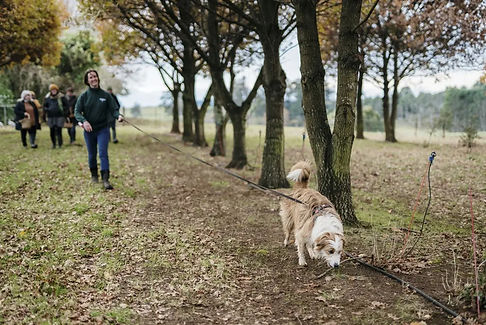


Truffle Hunt & Harvest Lunch in Tasmania includes a real-life truffle hunt followed by a delicious four-course truffle feast with wine pairing. Images courtesy Taste Marketplace.
You describe Taste Marketplace as a response to a surprisingly simple problem. What did you keep encountering as a traveller that convinced you there was a gap worth filling?
We have become so used to the big players in the tourism space. The big platforms, such as Tripadvisor and Viator, pull in massive product feeds and sell every tour you could think of. Yes, they probably have a lot of the same inventory as Taste Marketplace, but the food tour I’m looking at in Taiwan might be listed next to a motorbike tour in California. So there’s nothing that tells me that the experience I’m selecting is going to be tailored to me as someone who is genuinely interested in an authentic food experience.
In the past I’d generally use those platforms as a starting point, then work out who the operator was and look them up independently to see whether it was something I’d actually want to do. I was genuinely surprised that, time after time, I couldn’t find a platform that combined destination information with selected experiences that gave me confidence to book. So I built it because I needed it, and the continuing research on the rise of food tourism told me that other people needed it too.
How has studying food tourism changed the way you think about what travellers are really looking for when they sit down at a table or join a food experience?
A lot of people don’t know what they are looking for, and that’s OK. We don’t have to. Often the best part of travel is when you are surprised by something new. I think the study aspect highlighted both sides for me, in that it is so important for cultures to preserve their food traditions, because without them doing that, as travellers we wouldn’t have that available as something to experience. There’s also the importance of making sure experiences are authentic and benefit both the host community and the traveller. So much goes into making that work well together, so it was great to learn more about that.
Solo travellers often find that sharing food with local people or fellow travellers can become one of the highlights of their travels. What kinds of experiences have you found create those moments of connection most naturally?
Solo travellers are often open to so much more, as they have chosen to do something on their own. I’ve travelled to a lot of places on my own, largely because nobody wanted to or was available to go with me at the time. I don’t like that stopping me from going at all, so I’d rather go on my own. I think that in itself opens you up to more meaningful connections, because you’re not worried about the person you are travelling with, only yourself. You listen more, are engaged more, and make better connections with the people around you.
From my experience as a solo traveller, the experiences I enjoy are the smaller, behind-the-scenes type, where I might get to speak with a farmer, a restaurant owner, or a chef. I enjoy asking questions. That’s very much personality dependent, though. I have other friends who travel solo but who would prefer a larger group so they can blend in more and not feel like they are on their own. There is no ‘one-size-fits-all’ approach to solo travel.
As you develop the platform, what will determine whether an experience deserves a place on the site?
Firstly, because I travel so much for food, I look at an experience and decide if it’s something I’d like to do. If it is, that’s the first box ticked. Secondly, I look at the destination as a whole – what they offer, is it a foodie type destination in general, is it a wine region, will there be multiple things for a culinary-curious person to do, will it add value to their experience – because those are the kinds of questions I ask. The more boxes it ticks, the more of a no-brainer it becomes.
Then there’s always investigating things like existing reviews to make sure it will deliver on what it promises. I might reach out to the experience provider directly. The biggest challenge is deciding which destination to look at next, because there are so many incredible food-forward options that the list keeps shuffling around. I have so many more experiences to add for Australia first, though, so I will keep adding those while working out where to focus next. I am always open to suggestions!
To explore Taste Marketplace, visit the website here.