
THE SOLO TRAVELLER
Your world. Your way.
Inspirations

Jen with one of her guides, Phunjo Lama, on the summit of Mount Everest. Image courtesy Jen Willis.
Tending the seeds of possibility and promise
A Q&A with Jen Willis
Briefly …
Just weeks after standing on the summit of Mount Everest, adventurer, educator and author Jen Willis reflects on resilience, identity, uncertainty, and the long path that carried her there while living with Multiple Sclerosis.
When Jen Willis was a little girl, her grandfather gifted her a brooch – a small ice axe and mountaineering boots. “A little seed was sown, and a dream began to grow – that one day I would climb a mountain,” Jen recalls. “Forty-six years later, I stood on the top of the world.”
Congratulations on reaching the summit of Mount Everest! Can you take us back to the moment you realised you were actually standing on top of the mountain?
After climbing in 2023 and reaching the South Col but not having the chance to attempt to summit and then being back and this time reaching the summit, I imagined it would be an incredibly emotional and overwhelming moment. But honestly? In that exact moment, it actually felt anticlimactic. Every few metres as we were nearing the summit, one of my guides, Mingma, was saying “We are nearly at the summit, we are nearly at the summit!”, and there was a brief moment when I was just flooded with emotion and with a sense of disbelief that I was actually about to make it.
We had moved a bit faster than I had imagined we would, and we were under a full night sky, with just our torchlights lighting up the landscape and shapes around us. And then suddenly Mingma was saying, “Everest summit!”, and there was a sign marking the summit and prayer flags, and there we were, on the top of the world.
I had imagined this moment so clearly – standing there looking out at the world below me, and while I know it was there, my torchlight didn’t extend quite far enough to see it. But what I do get to carry with me is the feeling of the strong cold winds pushing me around as I made those final steps, and the knowledge that as I stood there, I was one of only a small number of Australian women to stand there on top of the world, one of the oldest, and the only one with MS and I had made it!


The “5-ladder crossing” involves five standard aluminium mountaineering ladders lashed together to bridge a massive crevasse; and Phunjo Lama leading the way as the summit attempt begins. Images courtesy Jen Willis.
Did reaching the summit feel like an ending, a beginning, or something more complicated than either of those?
Not long ago I wrote a book, a memoir. It’s called ‘How far would you go to find yourself?’. It emerged after my 2023 expedition, when I came home without summiting to challenges in my life that needed navigating, and found myself falling into an emotional abyss. I realised that what I was seeking in that climb was to outclimb a whole lot of life challenges that somewhere in my psyche I thought would magically disappear if I could stand on top of the world – that I could transcend everything that had been weighing me down.
When I didn’t summit, I was forced to face these challenges and ask myself some very big questions around who I was and what I needed to do to find my way back out of that abyss. I did a lot of inner work and emerged with a much stronger sense of myself. This time, I climbed with inner ease, carrying my childhood dream to one day climb big mountains in a simple, easy pure way. Reaching the summit felt like an honouring of that little girl with big dreams!

Climbing a wall of ice on the way to the summit during Jen’s first summit attempt in 2023. Image courtesy Jen Willis.
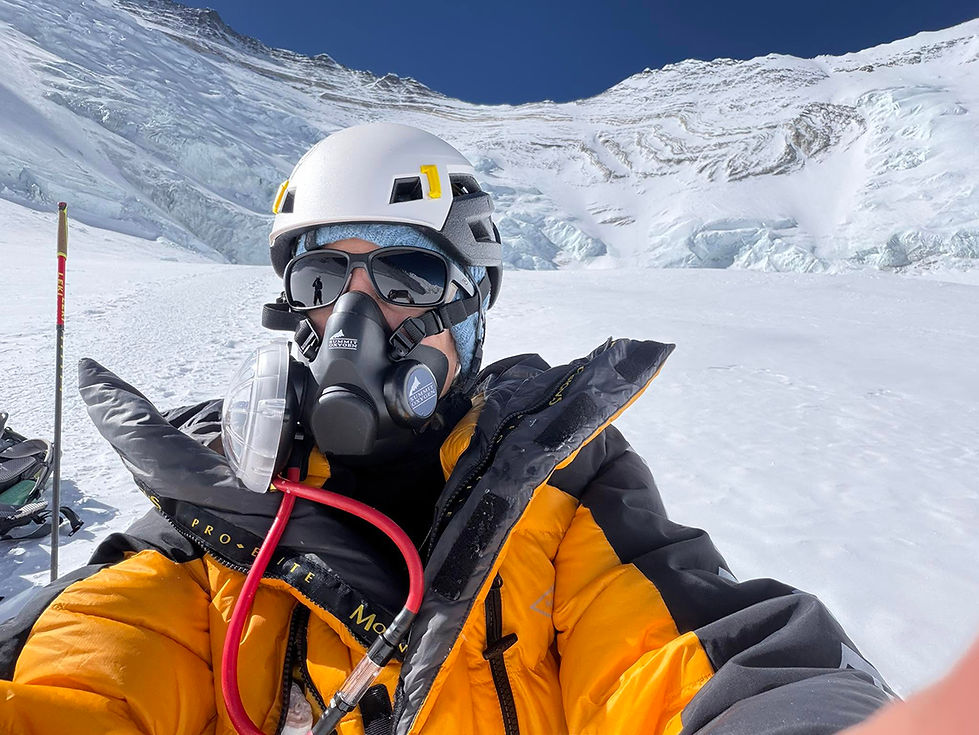
Ready to begin the summit attempt again in 2026. Image courtesy Jen Willis.
Living with MS while climbing Mount Everest challenges many assumptions about capability and limitation. Did the experience change the way you now see yourself?
I wouldn’t say it changed the way I see myself, but it did reinforce something I already knew – that I am not someone who gives up easily. It also reminded me that success isn’t a sudden or fast race to the top, it’s one step at a time towards a goal, and that when we slip back, we just step forward again and continue the journey. It’s not bold or exciting or glamorous in the moment, it’s small and it’s steady and it’s a commitment to just another step.
There was definitely uncertainty about whether I could actually truly summit with MS. I had no idea myself, as MS certainly threw in additional challenges such as temperature regulation, bladder function, energy and fatigue, and I likened myself climbing to driving a two-wheel drive up a four wheel drive track and pushing it to the limits.
What I know now is the limits are only perceived until they are reached and the more we gently extend them the greater what we can achieve becomes. It’s not MS that defines us, it’s how we choose to navigate it, challenge it and define our own limits living with it.

“There is still a lot of uncertainty about what will happen with the route up the mountain. If you are going to be stuck waiting, it’s not a bad looking place to be stuck!”. Image courtesy Jen Willis.
Mount Everest is often portrayed as a triumph story, but many climbers describe the mountain as humbling rather than victorious. How would you describe your own emotional response to the climb now that you are safely back in Kathmandu?
Definitely more towards the humbling end of the spectrum. There was not a moment when I felt that summiting was ‘a sure thing’. So many factors need to align, some within our control and some not. This climb was somewhat unusual as the route up the mountain is reliant on ropes being fixed from Base Camp to the summit. A large serac (an unstable, 100-foot-tall [30m] tower of glacial ice roughly the size of a 10-story building) at the top of the Khumbu Icefall (between Base Camp and Camp 1), meant that for a couple of weeks it was not possible to climb, so it was not possible to do the typical acclimatisation climbs up and back down the mountain.
On top of this, I picked up a virus that knocked me down for a couple of weeks, so by the time we left Base Camp to go up the mountain, I was not nearly as acclimatised as I would otherwise have been. Even so, we made the decision to only climb up once and just make one big push for the summit. By the time I arrived back in Kathmandu I felt completely physically wrecked! It’s very hard to feel victorious when just walking a few steps feels exhausting, when relying on adult diapers to manage my now completely disrupted bladder and bowel when I was so dehydrated, and so skinny I looked a good 10 years older!
People at home are so impressed I summited Everest, but at the end of the day it feels like it was just a slow and steady climb up a mountain, and then a long, fumbling, tumbling struggle to make it back down! I do feel proud, but I certainly don’t feel like I now have any magical new super power or capacity.
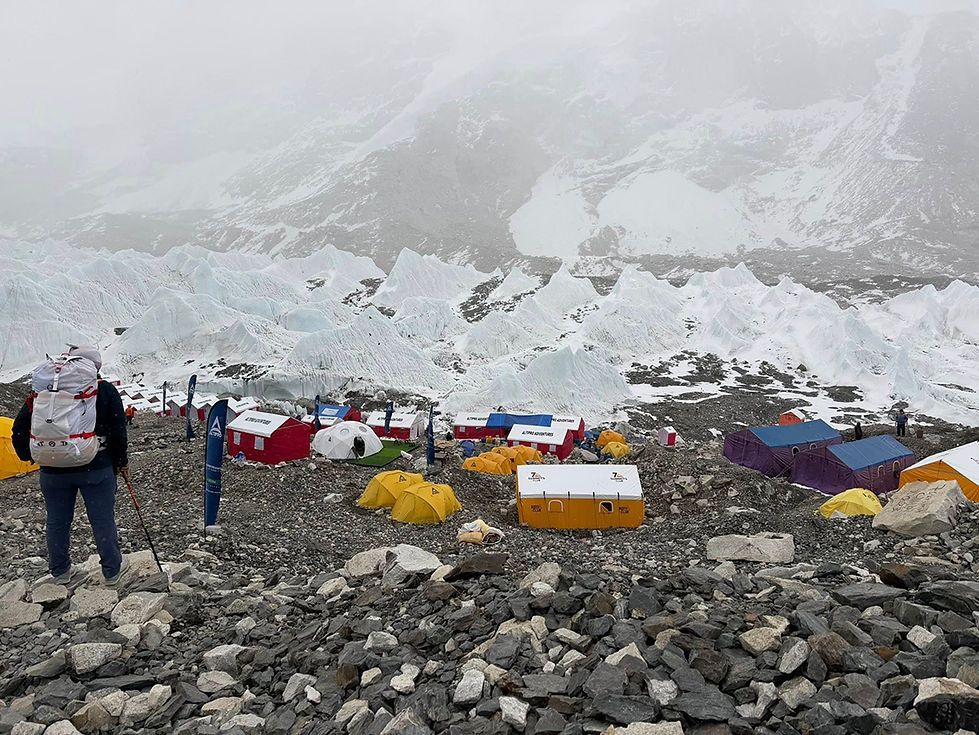
Everest Base Camp. Image courtesy Jen Willis.
Reaching the summit is only part of the journey, and many climbers describe the descent as equally dangerous. How did your relationship with safety and decision making evolve throughout the expedition?
Reaching the summit felt easier than I imagined, but as they say, it’s only halfway, and coming down was a whole different story. I realised just how quickly things could go terribly wrong. I have worked in outdoor education for much of my life, and my relationship with risk, and my understanding of risk management is well developed, and my decision making has always been very solid. But Everest and high altitude changes the game significantly. It’s the one place where I am relying not just on all the necessary safety equipment, such as ropes and harnesses, but on an apparatus that I need to actually keep my body alive – supplemental oxygen. If this fails, the consequences can be disastrous.
I am used to being the decision maker and being in as close to full control as is possible on trips. On this journey, I relied not just on myself but on the knowledge and expertise of my guides, on their judgement calls around how much oxygen would be needed, on flow rates, on monitoring the equipment, and that required a huge amount of trust. We ended up running low on oxygen, which created additional challenges, as no matter if we have grown up in the Himalayas or at sea level, at the top of the world we are all at risk of becoming hypoxic. Hypoxia is a dangerous medical state where your tissues and organs don’t receive enough oxygen to function properly. It impacts our mind and body, and it can easily become a situation where everyone has to focus on their own survival. Remembering this, and not expecting anyone to be super human, is so important.
When we choose to climb Mount Everest, we choose to assume a certain amount of risk, and we need to carry that with us the whole time, as our choice can never lead to anyone else having to take responsibility for that and risk losing their own life to save ours.
During difficult moments, what kept you grounded and mentally steady? Was there a particular thought, person, or sense of purpose you returned to?
I thought about what it would feel like to return home safely, having kept the promise to my kids that I would – a promise that deep down I knew I couldn’t truly make. Each time I thought about this, I knew that I had to simply just be in the moment I was in and not make it any bigger in my mind than it actually was – to just accept it, embrace it, and move through it.
There was a moment on the way down from the summit when I was just so spent I honestly did not know how I was going to actually make it down. After reaching the summit in 50km/hr winds and a temperature around -30c, and climbing at night without any eyewear on, my corneas froze! And frozen corneas make it very, very hard to see. Essentially it was like trying to look through heavily frosted glass. I lost all depth perception and could not make out anything around me with any clear distinction at all. Each step I took relied on looking so closely at what was in front of me to land my feet securely, and over time, my neck and back went into spasms and I became completely exhausted.
We had been on the move for over 18 hours to the summit and back down, and I just sat down on the slope and cried. At this altitude, there are no choppers, my guides were also tired, and no one was about to come and carry me down, so my choice was either to stay there crying and give up or get back up and keep going. It’s not really much of a choice, but more a matter of somehow finding it within to stand up in the moment and take another step and another and another until the destination is reached.
Did Everest reinforce anything you already believed about resilience, or did it challenge some of your assumptions?
It reinforced that resilience is like a muscle, and the more we use it the stronger it gets. When we use it in new environments, no matter how strong it is it can still falter under load. My strength definitely sits in my mind more so than my body, but I can push myself and I do have mental endurance. I can also cry like a baby occasionally, which tends to take me and others by surprise as I appear very resilient. Just occasionally, the load gets a bit too heavy, and my mind’s resilience muscle isn’t quite there yet!
Adventure culture often focuses heavily on physical endurance, but less attention is given to emotional vulnerability and fear. How important was honesty with yourself during the climb?
During the climb, and in life, honesty is incredibly important. Being real, open and honest allows us to truly experience life in all its amazing dimensions, and I love to just feel life! I have always been committed to sharing the good, bad and even the ugly. The inner thoughts and feelings that motivate us, make us question ourselves, and even berate ourselves – we all have them, and being able to be open and accepting of this allows us to journey through life with much greater acceptance for ourselves and for others.
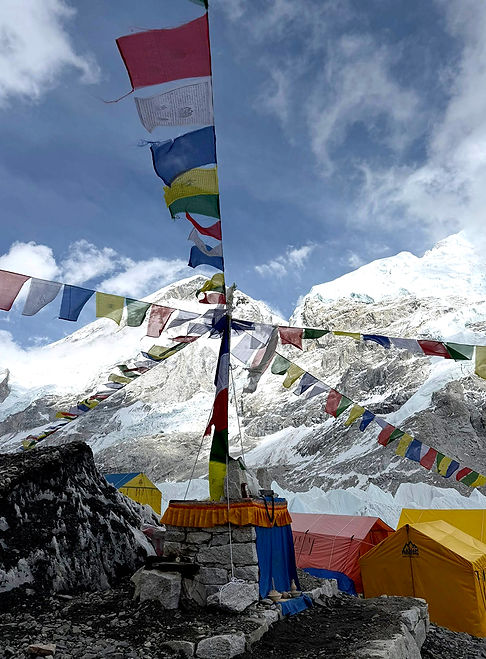

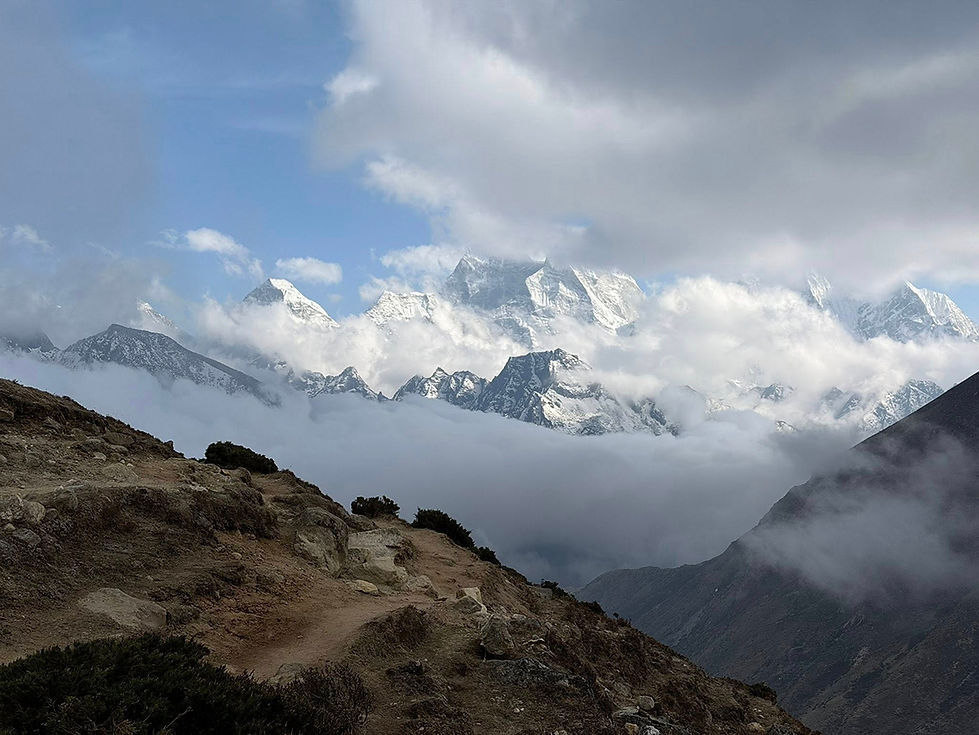
Exploring off the beaten path between Dingboche, a Sherpa village that serves as a vital acclimatisation stop, and Everest Base Camp. Images courtesy Jen Willis.
Returning home after a major expedition can sometimes feel strangely disorienting. How are you processing the transition from Mount Everest back into everyday life?
I have come home to busyness! I have three kids – 25, 21 and just turned 18. The eldest lives in Brisbane, the youngest in Colorado and the middle one with me. All three have been here to celebrate my youngest turning 18 and so time together was a priority. And then working out an income as I arrived home to not being employed and having to sort that out. I imagined coming home to socialise and celebrate, and I am still planning on doing that sometime soon!
Many solo travellers are drawn to challenge, reinvention, or testing themselves in unfamiliar environments. What do you think difficult journeys reveal about people that comfort often conceals?
I think we truly get to know ourselves. Comfort takes away decisions and solo travel opens them up. In each decision we make, we get a window into who we are. I spent a week up at Namche Bazaar, a town on the way to Everest Base Camp, with the goal of increasing my fitness before meeting Phunjo Lama, my amazing guide. On my walks above Namche there were some unique decision-making moments: keep going when the weather was closing in, follow the main path with other people, or wander off the beaten path and into unknown territory on my own.
In each of these moments I found myself alone off the beaten path and loving it! I loved feeling my sense of adventure driving me, wondering if I was being too bold but venturing on regardless. I loved arriving on the top of hills with no one else around and sitting and soaking in the most amazing views that I had all to myself. I loved feeling that my sense of adventure was truly just a part of me, that it lived within me, that it always had, and that my journey was not about proving or showing or sharing – that in the most intimate moments it was about being with myself and just being me.

Jen preparing to meet her guide, Phunjo Lama, to plan their next steps toward the summit. Image courtesy Jen Willis.
For people facing uncertainty, illness, or major personal change, what do you hope your journey represents?
I want people to think, “If she can do that, I wonder what I can do?!”. I did it while peeing myself into diapers the whole way up and down the mountain, struggling non-stop with temperature regulation, overheating constantly (which would drop my pace from reasonable to sloth in an instant), navigating endless dietary challenges, having to be so careful with energy so as not to bring on extreme fatigue, many racing trips to toilets that ranged from holes in the ground to balancing on rocks, to not quite making it and the aftermath.
There was very little that was easy or glamorous, but the rewards were immense. The people, the views, the sense of achievement and accomplishment of knowing I did it. I hope it represents that we don’t need to start out remarkable in any way to have a go, take on lofty goals, or pursue big dreams. We really just need to be prepared to be a little uncomfortable and to embrace this.
Mount Everest has become increasingly commercialised and crowded in recent years. Having experienced it firsthand, what realities of the mountain do you think are most misunderstood from afar?
I think there is a sense that climbers are pretty selfish, and that they rely on guides who are sacrificing so much just so climbers can achieve their summit dreams. But what I have realised is that for these guides and many of the Sherpa community, there is also the reward of the summit and they feel it too. They are drawn to the mountains, and as climbers we create an opportunity for a livelihood that many of them truly love.
Climbers often describe Mount Everest as both beautiful and brutal. Was there a moment during the expedition that will stay with you more vividly than the summit itself?
There is. It was on our way up to Camp 4. We had passed below Lhotse Camp 4 and were traversing along to the base of the Geneva Spur. The sun was going down, and we had been on the go for almost ten hours and I was exhausted. But just for a moment, I looked back across at the view, and I had a true sense of being right up near the top of the world, and it was the most breathtaking view and feeling I had on the whole trip. Snowcapped mountains rising above clouds like giants as far as I could see. That moment filled me so deeply I thought that if I didn’t summit it would be enough … but would it really? This moment filled my soul so completely, and I found my true second wind and climbed up the Geneva Spur about twice as quickly as I had been moving, feeling a strength in my body that was incredible.

“A Puja is a sacred Sherpa Buddhist blessing ceremony held at Everest Base Camp before climbers are permitted to move higher onto the mountain. The ceremony is conducted to seek blessing, protection and safe passage from the mountain deity before entering dangerous terrain like the Khumbu Icefall.”. Image courtesy Jen Willis.
Now that you’ve achieved something that once may have seemed unimaginable, how has your definition of success evolved?
I honestly don’t know. After the first expedition, where I felt ready to summit and didn’t get there, the feeling of success felt unattainable for months afterwards. Even though I had still climbed to new heights, it was overcoming the depths of disappointment and climbing out of the mental abyss that felt like the real success then.
This time, I don’t really feel a deep sense of success yet, rather I have this niggling sense of incompletion right now and I am not 100% sure why. I suspect it is because the story I once told of climbing with MS would be of how amazing it would be. Even if my health declined and my walking was impacted, I could summit Mount Everest and I could hang my summit certificate on my wall and I would always have it there to look at, knowing that even with MS and in my fifties, I was able to climb to the top of the world! I suspect when the certificate arrives, with it will come this feeling and that may be what success for this adventure feels like.

Jen with Phunjo Lama – her “guide, friend, and my living legend”. Image courtesy Jen Willis.
And the seed that grew from the little brooch my grandfather gave me? For 46 years that little seed was slowly fertilised and watered and grew. Sometimes with intention, sometimes by chance. There were times it lay dormant and times it called out for attention and a promise it could grow, until one day it became a mountain summited.
We all have these seeds of possibility and promise within ourselves. Tend to them.
Jen would love you to donate a little to MS research in the quest for a much needed cure, and you can do that here. You can also donate to help with Jen’s post-expedition costs that she will carry for a good few years yet here.
You can also connect with Jen via her website here https://jenwillis.com.au/, and on Instagram here.