
THE SOLO TRAVELLER
Your world. Your way.
Health and Wellbeing
Social anxiety … and the subtle art of eating alone
By Tom Holland-Pearse
Briefly …
For socially anxious introverts, the smallest solo traveller moment – sitting down for a meal alone – can feel like the hardest. Tom, a certified Cognitive Behavioural Therapy (CBT) therapist, explores the fears, avoidance habits, and inner monologues that can turn restaurants into battlegrounds, and shares gentle, practical steps to reframing those thoughts, staying present, and finally enjoying the experience (and the vegetables).
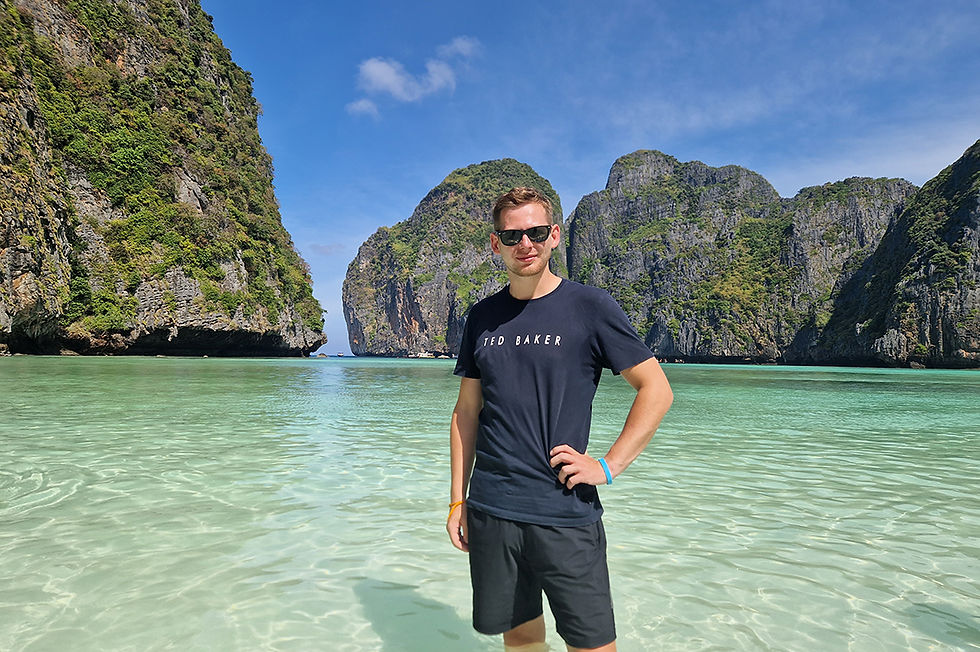
It was three years ago when I first decided to put my life on hold and buy a one-way ticket to Southeast Asia. Relatively safe, tourist-friendly, and with an almost unlimited supply of fellow backpackers to share it with, I felt confident enough as I finessed my packing list and headed to the airport.
Travel plug, check.
Sleeping mask, check.
Imodium, check.
Nothing could stop me!
I’m also something of an introvert, so as much as I felt reassured knowing other travellers would always be close by, I was equally determined to remain largely solo. I didn’t want to burn myself out, and I wanted to properly connect with the culture and surroundings in a way that felt right to me – not through boozy, reckless escapades fuelled by herd mentality. I needed to be alone if I was going to fully immerse myself in this experience … or so I thought.
On top of my introversion, I also have a history of social anxiety. I’m a walking paradox in that, as much as I desperately crave being on my own, the thought of walking into a restaurant or complaining that my food order was wrong feels about as compelling as eating my travel pillow.
And that’s the other thing about travelling – you have to eat … a lot. Three times a day? Madness! It can feel strangely insurmountable. So, how then does a solo traveller, who clearly intends on consuming some level of food during his expedition, manage and cope with this seemingly necessary evil?
In short, quite sneakily. By the end of the second week, I was the master of avoiding situations in which I thought I would fail or be embarrassed. My diet consisted of an almost constant stream of 7-Eleven sandwiches, instant noodles, and chocolate – anything except walking through a busy restaurant’s doors and asking for a “Table for one, please”.
“My diet consisted of an almost constant stream of 7-Eleven sandwiches, instant noodles, and chocolate – anything except walking through a busy restaurant’s doors and asking for a “Table for one, please”.”
On the rare occasion I did manage to push through my anxiety and walk through the revolving doors of an actual restaurant, I would sit, order, and immediately glue myself to my phone … Facebook, Instagram, even Tinder – anything to appear busy and occupied. And although this coping strategy did enable me to do just that – cope – surely I hadn’t saved all this money and counted down the days for so long to read the same banal article I had been reading back home?
Something needed to change. I wasn’t living my best life. I wasn’t connecting with the people or the culture. I needed to eat some veg!


As a Cognitive Behavioural Therapist, my bread and butter is helping people understand how the way they think affects the way they feel and act. And if my thoughts were misaligned with reality (generally skewed towards the negative), then so would my feelings and my actions.
‘So’, I asked myself, ‘how exactly was I imagining these situations would go?’.
I pictured walking into a restaurant and being served by an attractive waitress who takes one look at me, alone, and immediately concludes I’m a complete loser. The staff whispering and smirking as I haul my lonely load towards my table for one. Couples in the corner are paralysed by second-hand embarrassment for me, and due to my chronic fear of judgement, I simply comply and order a starter out of pure politeness.
It’s not good.
It’s easy to understand how someone might feel paralysed before leaping from their hostel bunk, throwing on a shirt, and venturing out for a local dish.
This is when all my therapy training mattered most.
The key question is this: “Are these facts, or are these just your thoughts?”
There’s an art to recognising that just because you’re thinking something doesn’t make it true. You might already know this logically, but ‘knowing it’ and ‘believing it’ are two very different things. Sometimes you simply need to suspend your belief for a few moments and do the feared thing anyway.
Instead of imagining catastrophic scenarios, I tried this instead: simply notice that you are imagining scenarios. You are simply someone experiencing thoughts – fleeting mental events passing through the sky of your consciousness. Let them be there, gently or vigorously playing in the background, while you take three deep grounding breaths and decide what’s right for your mind and body despite what the anxious part of your brain is saying.
It might sound like this: I’m aware I’m having thoughts about being humiliated and embarrassed. And I’m also aware that if I eat at 7-Eleven one more time this week, I’ll probably develop scurvy. So, in the interest of my mind, body, and overall experience of life, I’m getting up and preparing myself despite the fears my mind is showing me.
This is called ‘Psychological Flexibility’ – the ability to experience thoughts, but to choose actions in line with your values and your needs regardless.
And it’s really bloody hard.


The final point I’d like to make is inspired by one of the great speakers of our time, the turtle from ‘Kung Fu Panda’: “Yesterday is history, tomorrow is a mystery but today is a gift. That is why it is called ‘the present’.”
More specifically, each moment is the present. And we are able to live in a moment-by-moment, present-focused state regardless of what our judgments and inner monologues tell us.
You may sit at the table with presence.
Ask for the bill with presence.
All while suspending your conviction in the inner monologues of self-judgement and criticism and remaining curious about the accuracy of those monologues at the same time.
Are those horrible images of my own humiliating demise actually coming true?
What differences are there between what I ‘thought’ and what actually ‘is’?
How well am I coping with all this anxiety?
Remaining present, flexible, and curious are the three key ingredients for managing social anxiety when eating alone, and these skills are especially important when you should be immersing yourself in the experiences of a wonderful, once-in-a-lifetime trip around the world.
So, don’t let anxiety steal another crumb of that experience from you – literally and metaphorically.
Tom Holland-Pearse is a certified Cognitive Behavioural Therapy (CBT) therapist based in Bristol, UK. Tom’s journey into better mental health began in a difficult place, when he felt lost, stuck, and unsure how to move forward. Through therapy, he discovered how powerful it is to talk openly with a trained professional and to learn practical tools for shifting unhelpful thought patterns and behaviors. That experience changed his life, and it continues to inspire the work he does today.